ReShiki 0.7.0
Chemical drawing, reinvented.
Version 0.7.0 improves molecular editing, coordination drawings, image-assisted reconstruction and desktop updates. The illustrated change log includes all 37 feature updates, screenshots and a hands-on checklist from PR #17.
Draw and edit with consistent geometry
Section titled “Draw and edit with consistent geometry”- Bond junctions share continuous outlines, removing small white seams. Solid, hollow and hashed wedge tips retain the configured normal bond width.
- Moving a bonded atom or collapsed group follows the configured bond length and angle grid. Hold Option/Alt for free movement; complete molecules translate freely.
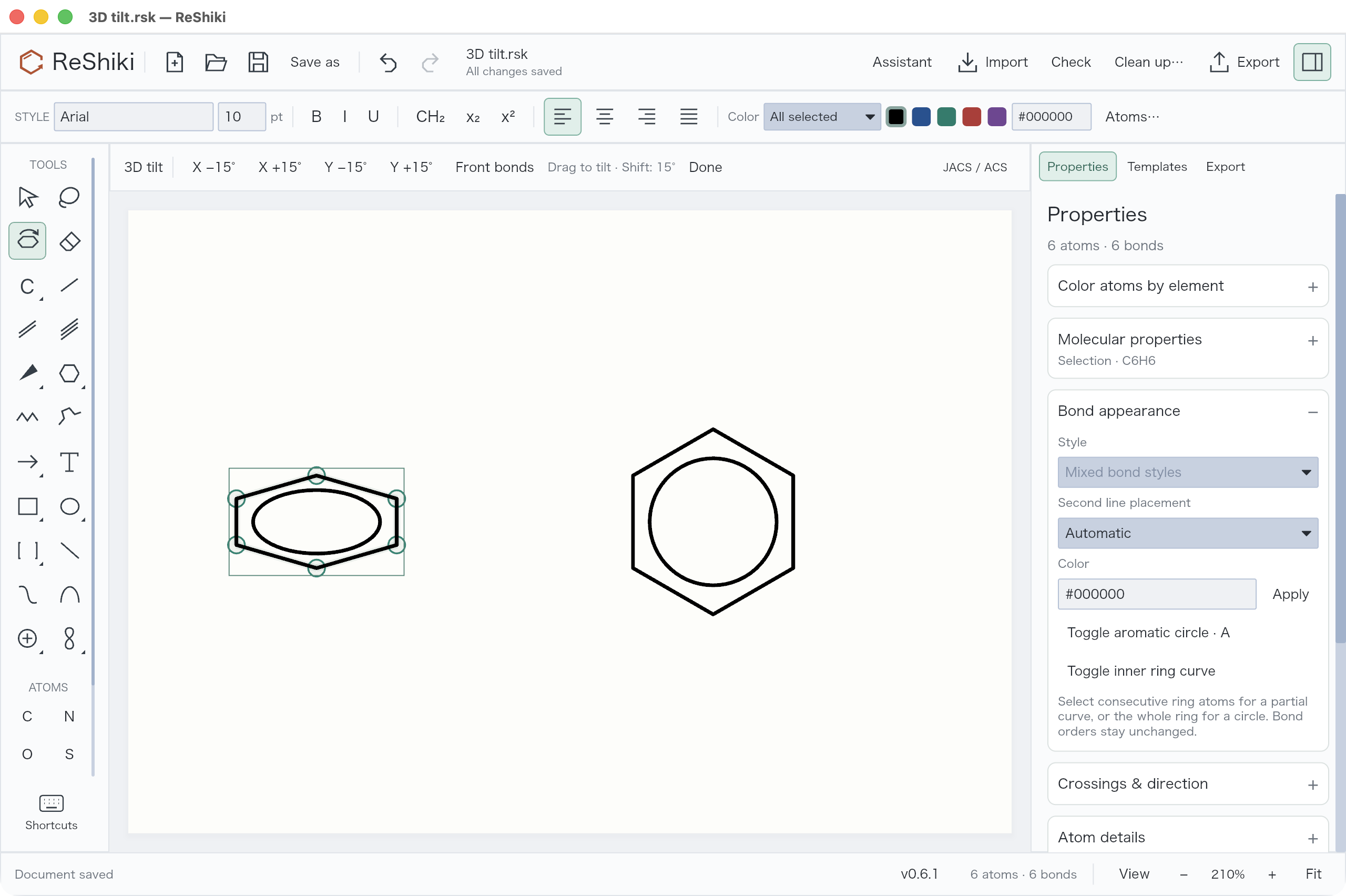
- Select the 3D tilt tool and drag to preview a projection. Hold Shift to snap to 15°. Right-click → 3D tilt also offers step controls. Each drag is one Undo step; labels stay upright and ring circles follow the projection.
- The right-click menu groups commands for the current selection. Ring-interior selection now includes aromatic and substituted rings.
- Shift+R switches saturated/aromatic drawing while preserving ring size, or converts a selected complete ring. A changes the depiction of an already aromatic ring.
- Inner ring curves show partial delocalization without changing bond orders. Atoms… recolors matching elements in the selection or whole drawing.
Keep chemical groups and attachment meaning
Section titled “Keep chemical groups and attachment meaning”- Atom-label editing accepts element symbols, defined chemical groups such as Boc, and literal labels such as M, L and X. Defined groups retain their atom/bond graph; literal text is a named wildcard, not inferred chemistry.
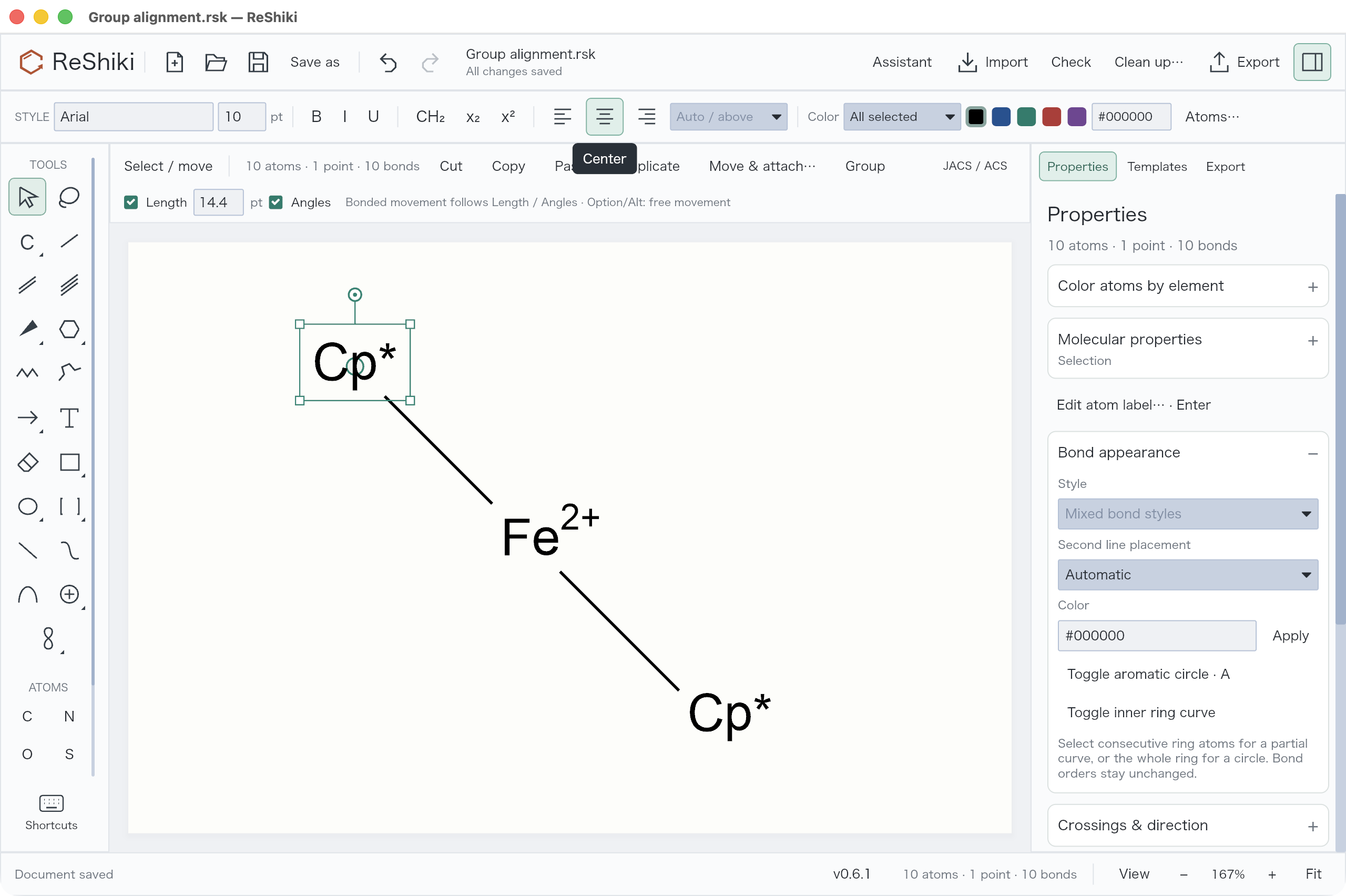
- Cp and Cp* represent cyclopentadienyl and pentamethylcyclopentadienyl with their full ligand graphs. Composition counts their atoms, excluding attachment handles. Cp₂Fe and Cp*₂Fe give C₁₀H₁₀Fe and C₂₀H₃₀Fe for the defined ligands and entered metal charge.
- Distinct multi-center and variable attachment nodes retain their target atoms through editing, copy, deletion, Undo and supported CDXML/CDX/V3000 exchange. η³-allyl, η⁶-arene, ferrocene and variable-position fixtures were checked in ChemDraw 26.
- Anonymous dummy/attachment handles remain visible while editing and disappear from figures and Office image output. Explicit labels remain visible.
- Group labels default to Automatic alignment. The existing top Left / Center / Right controls apply to groups and captions; the adjacent menu offers Automatic / Above. Alignment does not change the chemical graph.
- Cleanup preserves attachment-containing complexes and explains its geometry limitation while allowing independent ordinary molecules to be cleaned.
Work with image references
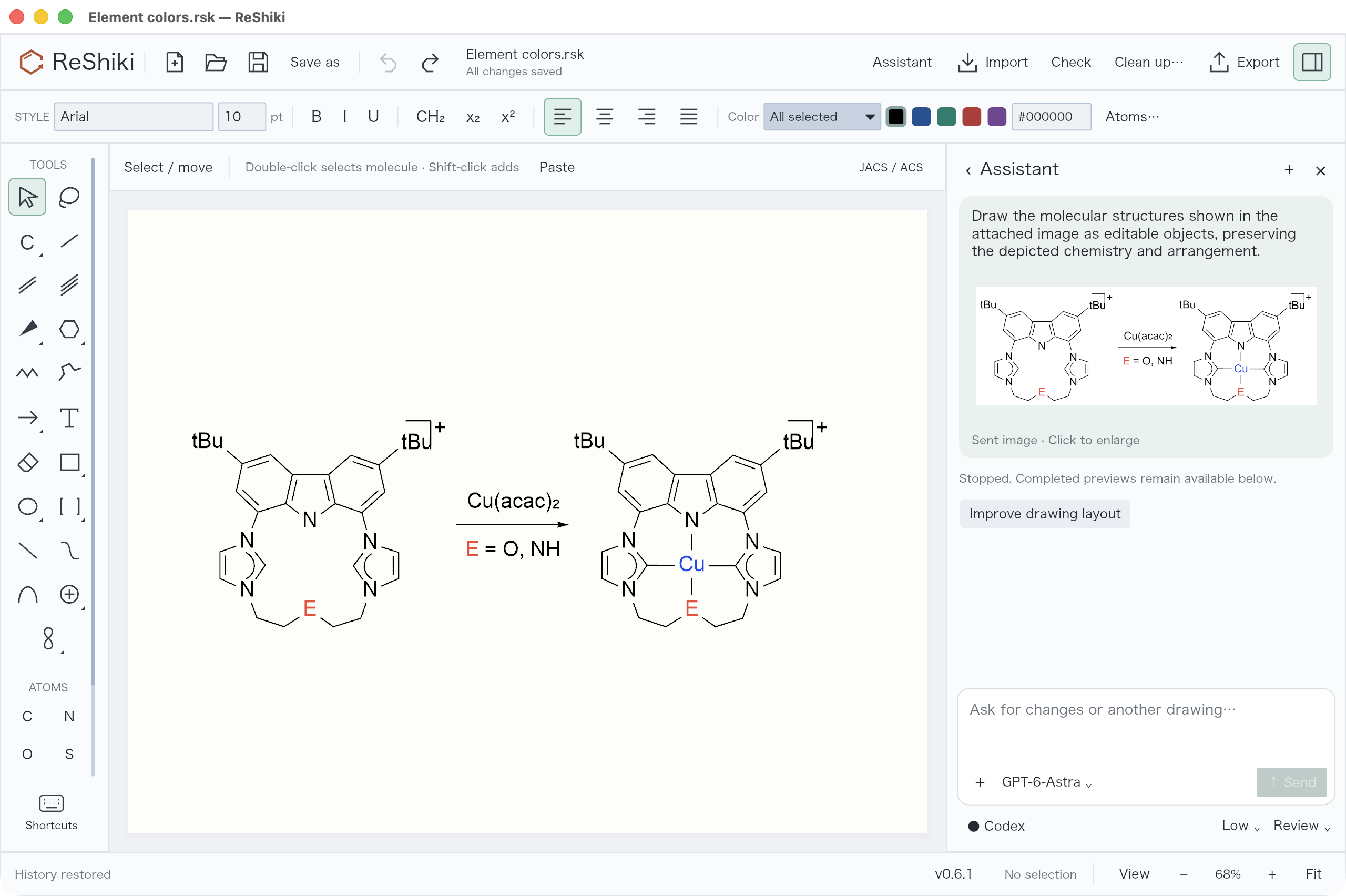
Section titled “Work with image references”The compact assistant accepts pasted or chosen images and passes them to the AI agent after Send. Sent images remain in their chat messages for later inspection; click a thumbnail to enlarge it. GPT-6-Astra is the default when available, while saved model choices remain intact.
Reconstruction favors the source’s flat layout unless perspective is visible or requested. Progress-aware timeouts distinguish inactivity from the overall turn limit and retain completed previews. Generated chemistry still needs review, especially for coordination complexes and ambiguous charges.
Update from the app
Section titled “Update from the app”Open ReShiki → Check for updates. When a newer supported release is available, Update and restart verifies the package, installs it and reopens the saved drawing. Automatic daily checks can be disabled and never install without a click.
Restart waits for unsaved drawings, atom-label edits, assistant drafts and unfinished input. Download/signature failures leave the running app intact; installer fixtures cover replacement and rollback. Native Windows/Linux updater UI and a real upgrade to a later published version remain separate validation work.
Format and chemistry boundaries
Section titled “Format and chemistry boundaries”Keep the .rsk original for all editing features. SVG, PNG and PDF retain the new drawing appearances.
- CDXML/CDX expands Cp/Cp* to preserve their attachment definitions when ChemDraw saves them. Partial ring curves, free wildcard text and projection-only front-bond emphasis are rejected by editable export until lossless interchange is available. Disable Front bonds for supported editable projection exchange; otherwise a bold depth cue can be interpreted as a stereochemical wedge.
- V3000 attachments require one bond per point and do not carry distributed charges/radicals. RXN attachment export is unsupported. Variable attachments do not define a unique formula, and composition does not validate metal coordination valence or establish a complex identifier.
- Above places a single nickname above its anchor; general multiline formula-token stacking is not implemented. Legacy drawing centroids remain nonchemical anchors.
- Chat history is retained during the current conversation, not across app restarts. The illustrated reconstruction fixture remains a visual regression with nitrogen-valence and caption-charge assignments requiring review.
See drawing validation, ChemDraw comparison and release validation for the evidence and remaining limits.