Adaptive chemistry limits: desktop validation
Engineering notes and historical checks.
Merged, unreleased, in PR #279, addressing #245 and #248. Contribution: @Ameyanagi, project creator and maintainer. These results describe the tested candidate; they are not a released capability or a guarantee for every eligible molecule.
Larger 3D drawings and fused-ring imports use bounded calculation budgets adapted to available machine resources. The resource policy explains the admission rules, allocator accounting, deadlines and fallbacks.
Source and application provenance
Section titled “Source and application provenance”The native desktop comparisons were performed on 2026-10-09, macOS 26.5.1 arm64,
using preserved signed application bundles. The baseline is
51fa0991da2507bb00b27c1b420e807468de6423; the candidate is
a018733f9bfc3cc08f73dbc82aadf0c261362f29. The candidate is a development build
with default features; cosmolkit-core is optimized at level 3. Both application
bundles were preserved separately from the shared build target.
The candidate executable SHA-256 is
23a492c762aedec1e8f8cf0133a48919c843776c31b01b8775fd7c0de31e0884.
Its build receipt identifies
all 15 compiled workspace artifacts as coming from
this candidate worktree and rebuilt (fresh: false). An independent read-only
audit verified all 1,063 retained source-file hashes and the executable hash
before adding this documentation. Later documentation commits do not describe a
new executable. The original receipts and captures are also retained outside
the repository; the independent audit
records the candidate, artifact count and fixture hashes.
All six JPEGs below are unchanged copies of actual application captures, at 2560 × 1704 pixels. There is no drawing export, crop, retouching or reconstructed UI. Both comparisons use JACS / ACS drawing style and Arial 10 pt. Raw images are reusable release-note material; the input and saved native files are included alongside the audit. The capture receipt records the raw JPEG dimensions, hashes and capture-condition differences.
A later CI follow-up moves only the worker’s unchanged cfg(test) module below
the production items and formats documentation. Production item text and all
test assertions remain unchanged; the reviewed executable remains source
a018733f, rather than a newly built CI-follow-up executable. The six formatted
JSON copies retain identical parsed values. Their capture hashes in the audit
refer to the original bytes at evidence commit
2f0e1e46bc4256269fc3de0bf9b9b0ac674bb478; use the immutable
raw worker request
and raw worker response
for that byte-level proof. Formatting changes the current request/response
SHA-256 values to b261cd65336e02164c51ce7d296dceef085d7e3ff46c6b505b710d7d3817526b
and 3552def87d36b1307b7b97f5bd544b5a0255655c5aa2fd483a6919ee42246b2b, respectively;
the JPEG and native-file bytes are unchanged.
513 original atoms: former size rejection to 3D preview
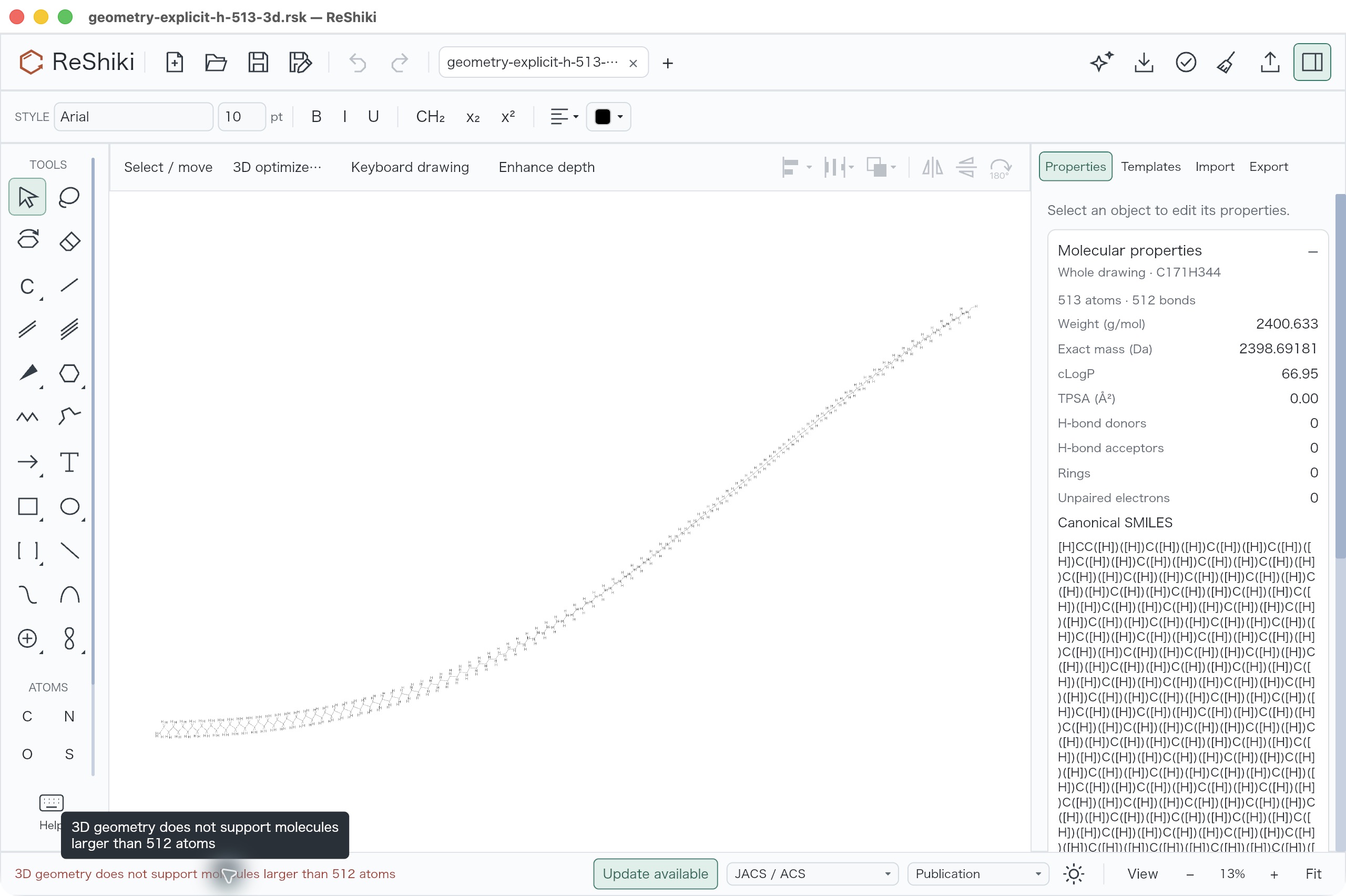
Section titled “513 original atoms: former size rejection to 3D preview”Open the same native input in each preserved application, clear selection, and use Cmd+Shift+D on macOS (Ctrl+Shift+D on Windows/Linux) or 3D optimize…. This command is existing; the change adds no shortcut. Keep the default MMFF94s force field. Both captures use 13% zoom with keyboard drawing (F8) off.
This controlled input is one connected alkane with 171 carbons and 342 explicitly drawn hydrogen atoms: 513 original atoms and 512 bonds. It includes a valid nonplanar seed from the actual geometry backend. It differs from #245’s original 513-carbon input; it exercises the same original-atom size boundary while giving a practical desktop comparison. It tests reuse of existing 3D geometry, rather than new embedding of an unseeded large molecule.
| Baseline: 512-original-atom rejection | Candidate: admitted 3D preview |
|---|---|
 |
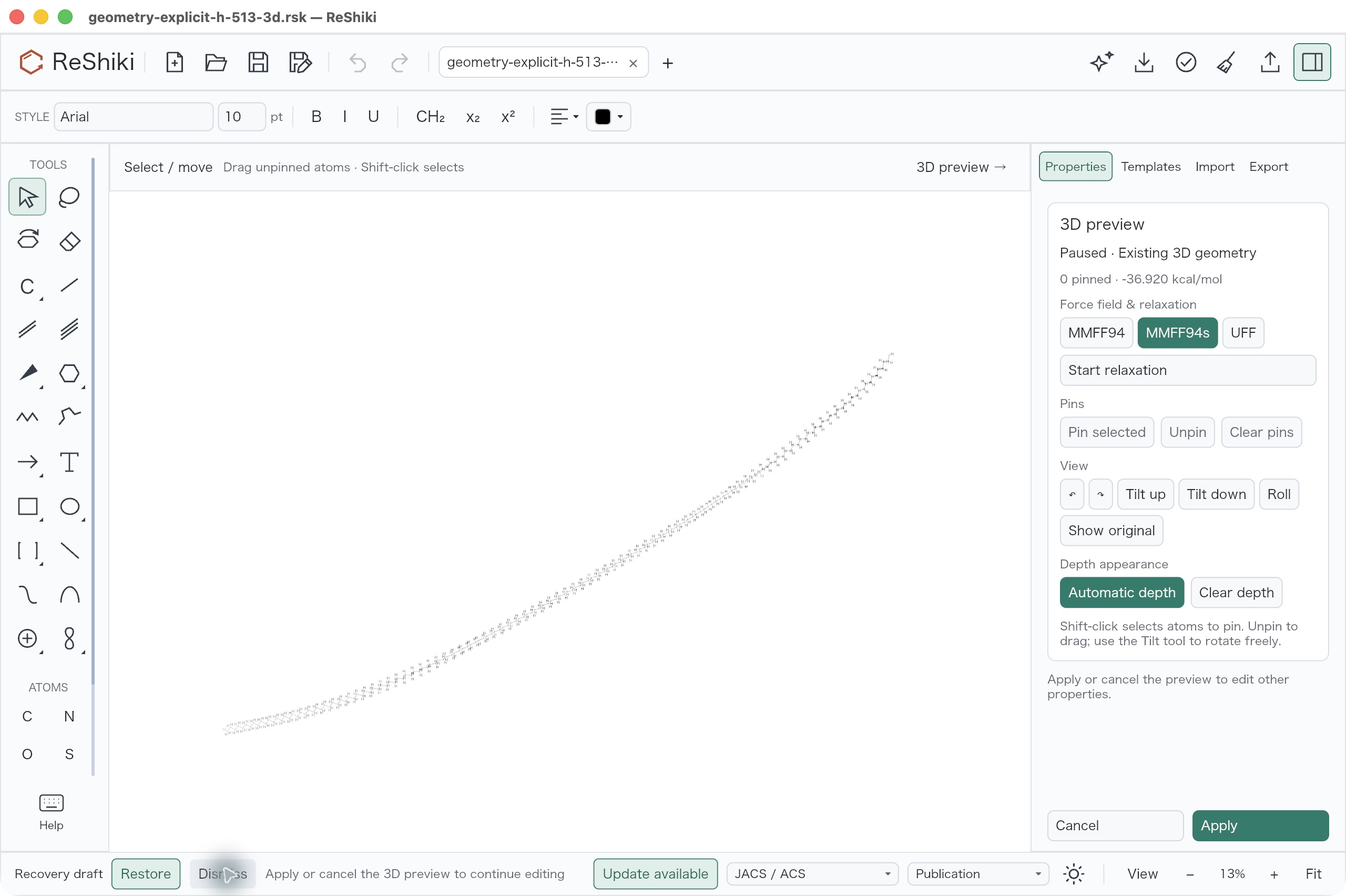 |
The candidate’s actual Properties panel shows Paused · Existing 3D geometry,
MMFF94s and −36.920 kcal/mol. The retained
worker request
uses a 512-MiB allocator budget, capacity for 640 original atoms and 4,096
coordinates, one conformer and 500 iterations. Its
response
contains 515 coordinates: the 513 originals plus two temporary hydrogens, both
mapped to original zero-based atom index 170. It reports
energy = -36.9198750543448 and converged = false. A complete finite preview
is not a claim of convergence or a global minimum.
The operator clicked Tilt up once, Apply, Undo once (restoring the original with a clean title), Redo, then Save As the desktop native result. The following raw capture is after Redo and before Save As; its modified indicator and transient property calculation are visible. This separate interaction capture also changes orientation by one tilt, unlike the matched preview pair.
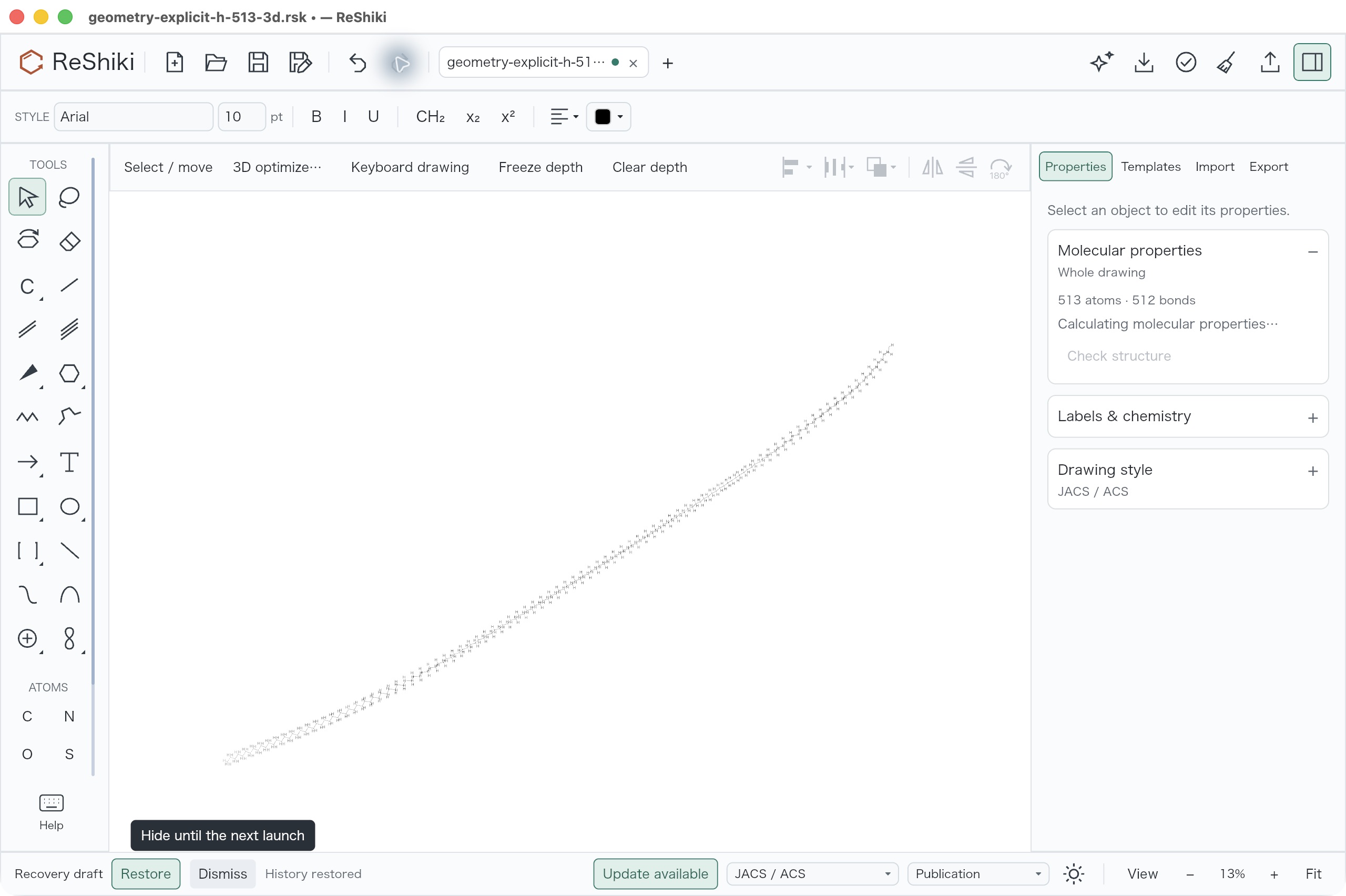
Independent native-file checks establish:
- All 513 atom IDs, elements, charges, isotopes, radicals, explicit-H and implicit-H flags, aromatic flags, stereo and atom-map fields match the input after normalizing absent native defaults. All 512 ordered bond records retain endpoint IDs, order, drawing style and stereo. Native bonds do not have a separate stored bond-ID field.
- The saved file contains 342 drawn H atoms; neither temporary force-field hydrogen becomes a native atom. All 513 saved XYZ triples are finite and have nonzero depth. Their orientation and translation differ from the input.
- The first 513 worker coordinates match the saved XYZ after a proper rigid view
rotation and the 28 scene-units/Å conversion. The independent checks find RMS
error about 4.65 × 10⁻⁶ Å and maximum error below 1.7 × 10⁻⁵ Å, consistent
with the stored
f32scene coordinates and the desktop tilt. - Rendering and serialization changes are distinct from chemical changes:
document version 1 becomes 19 with current default fields; derived H-label
cache
label_hat atom 171 changes from 0 to 2; automatic depth appearance records all 513 original IDs with strength 0.62.label_his a derived label field, separate from the preserved chemical hydrogen flags. SeeRefresh::apply,finish_preservingand the view projection.
The second independent geometry check records the proper-rotation fit and normalized chemical fields. Native Cancel was not exercised during this desktop session; queued cancellation and reservation recovery were covered by the retained model/worker control.
Large fused-ring import: work-limit error to saved drawing
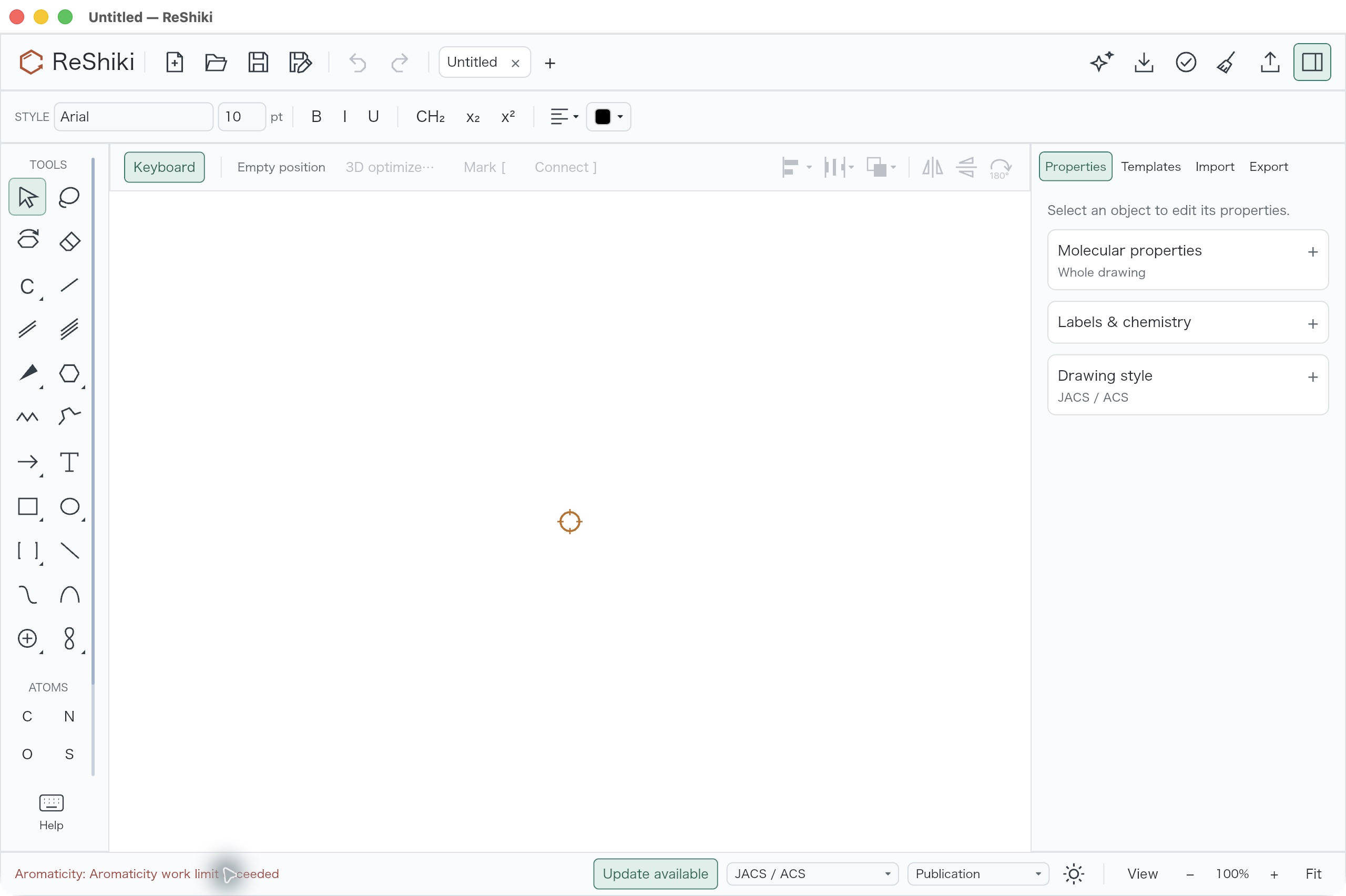
Section titled “Large fused-ring import: work-limit error to saved drawing”Create a blank drawing with F8 on and use File → Open on the identical SMILES file in each application. The issue originally used the Import panel; this desktop comparison checks the file-open import path with the same generated input:
"C12=CC=CC1" + "=CC=1C2=CC=2C1C=C1C2C=C2C1".repeat(37) + "=CC=C2";The baseline stays blank with Aromaticity: Aromaticity work limit exceeded. The candidate imports and depicts the drawing, and Properties reports C452H154 · 452 atoms · 601 bonds · 150 rings. The baseline’s blank canvas remains at 100%; the successful large drawing automatically fits to 10%. This is a failure/success import comparison, not a comparison at equal drawing scale. The successful interaction capture retains the visible orange keyboard focus marker because F8 was on in both initial runs.
| Baseline: import fails, blank canvas at 100% | Candidate: import succeeds, automatically fitted to 10% |
|---|---|
 |
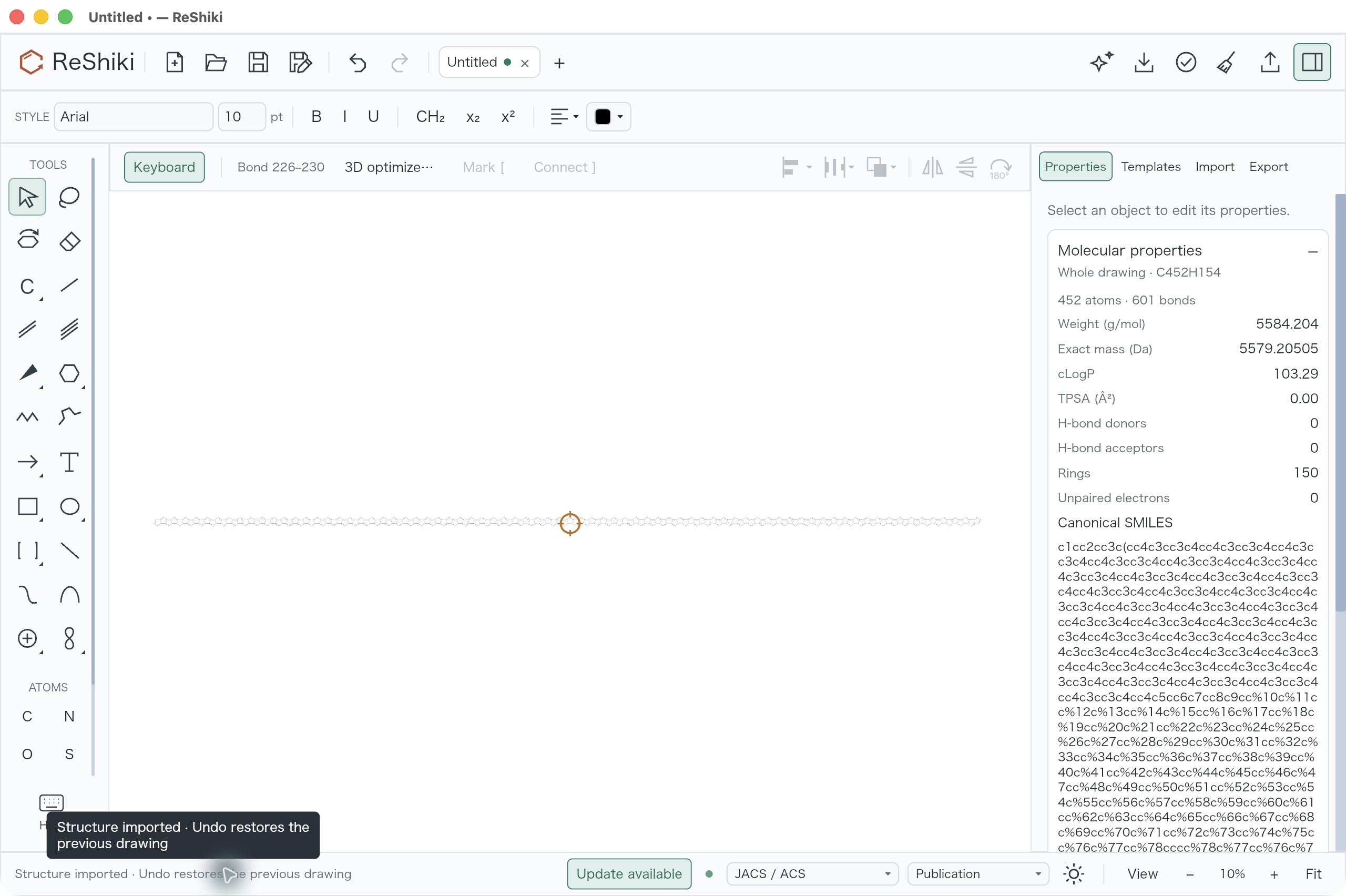 |
One Undo returned to a completely blank drawing with a clean title. Redo restored the graph. The operator then turned F8 off and saved the native result. This clean saved capture uses 10% zoom and has no keyboard focus marker:
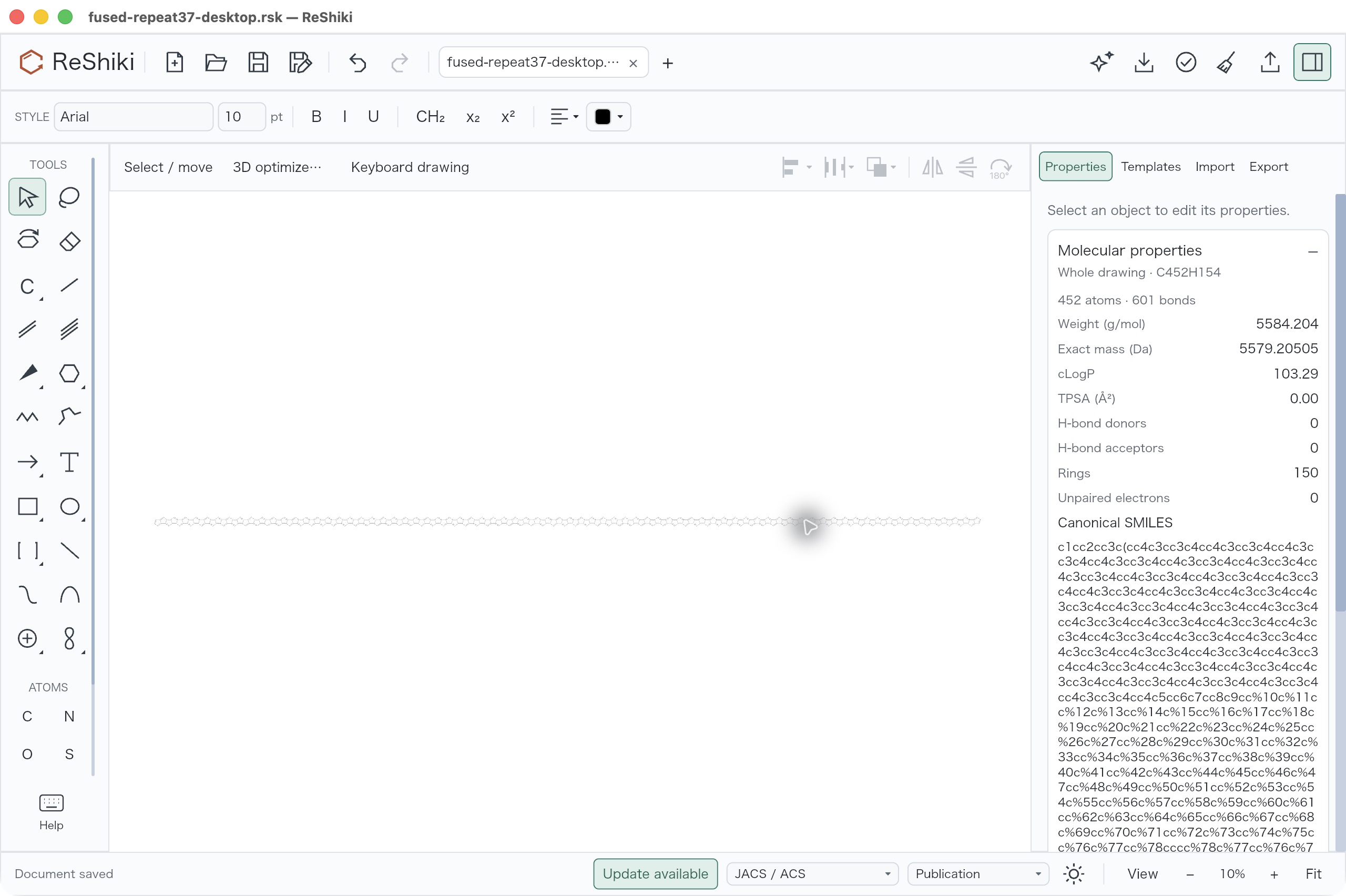
An independent check parsed the exact input SMILES and the saved native file. The 452 carbon atom records match the SMILES parser’s atom order and native ID assignment, including charges, isotopes, hydrogen flags, aromatic flags and stereo. Every endpoint pair and original single/double bond order matches. RDKit 2026.03.6 independently reports identical canonical isomeric SMILES, C452H154, one connected component and 150 rings. All saved coordinates are finite; this is a planar import with zero retained depths. These checks prove chemical correspondence for this fixture, not the visual quality of every large-molecule layout. The native derived H-label total is 154.
Resource policy and other checks
Section titled “Resource policy and other checks”The limit depends on available memory headroom, including readable process and container constraints, and a short bounded throughput observation. CPU count or installed RAM alone does not select it. Each operation freezes its budget; new operations can observe changing load. A 64/256/512-MiB geometry allocator budget admits at most 128/512/640 original atoms. Geometry deadlines stay within 60–120 seconds; aromaticity has its own 10-second deadline and bounded work allowance. Reservations account for concurrent calculations within one application process. They are not an allocator cap for the whole application or a cross-process reservation service. Unknown observations have bounded fallbacks; an observed exhausted memory constraint denies admission.
The retained sample observed 7,214,923,776 bytes of headroom and 3,533,459 lookup operations/s, resolving to 512 MiB, an 84-second geometry deadline, a 10-second aromaticity deadline, 35,334,590 work units and a 1,280-MiB aggregate reservation pool. This is a separate headless observation, not a measurement of the native GUI’s exact budget or elapsed time. The packaged worker completed its controlled request in 8.684 seconds; native desktop actions were not timed with a stopwatch.
The retained suites passed: aromaticity 11, native geometry 18, IO geometry 16, process heap 7, scoped four-package Clippy with warnings denied, formatting and diff checks. The independent aromaticity reference log records 31,019 cases, including 17,307 transformed graphs. Ordered exhaustive enumeration checks cover all labeled graphs through five vertices. The six-ring model rule and the two-ring rule above 300 fused rings remain unchanged. The repeat-37 regression uses 385,972 charged work units instead of exceeding the former 50-million-unit budget. Dense inputs can still exhaust their operational budget and return an error without a partially perceived graph. See the retained reference log.
Seeded backend probes at 513 and 640 original carbon atoms cover Generate,
Evaluate and pinned Relax under MMFF94, MMFF94s and UFF. The largest retained
640-carbon UFF generation charged about 421 million live Rust allocation bytes;
this is not RSS. The original 513-carbon family remains a heavier control: one
500-iteration request timed out at 60 seconds, a valid 120-second request
completed in about 69 seconds, and a retained calculated seed completed under
a resolved 75-second deadline in about 73 seconds. Completed controls still
reported converged=false. Thus admission at 640 does not promise that every
eligible request finishes, embeds or converges. The existing 511/512 seeded
controls retain exact baseline coordinates, energies and hydrogen mappings.
Native desktop evidence here is macOS only. Windows and Linux resource-probe runtime acceptance remains separate; cross-compilation and source inspection do not replace it. No new third-party material, external fixture dataset or dependency is bundled by this change; existing component notices remain in NOTICE.
Archived evidence
Section titled “Archived evidence”The historical evidence cited in this record is preserved in docs/fixtures/chemistry-limits on the evidence archive branch.
| Archived files | What they record |
|---|---|
| docs/fixtures/chemistry-limits | Source/capture provenance, 513-atom native geometry inputs and saves, fused-repeat import inputs, and worker/profile logs. |