Predict NMR shifts
NMR prediction estimates ¹H and ¹³C chemical shifts for one molecule from measured reference data. It runs on your computer.
Predict the shifts
Section titled “Predict the shifts”- Select an atom of the molecule. If the drawing holds only one molecule, you can leave the selection empty.
- Open Properties → Molecular properties → Predict NMR…. The results open in the NMR prediction palette at the right edge of the window.
- Choose ¹H or ¹³C.
- Click a row in the table, or a label above the plot, to select its atom in the drawing. Hydrogens drawn on that atom are selected too.
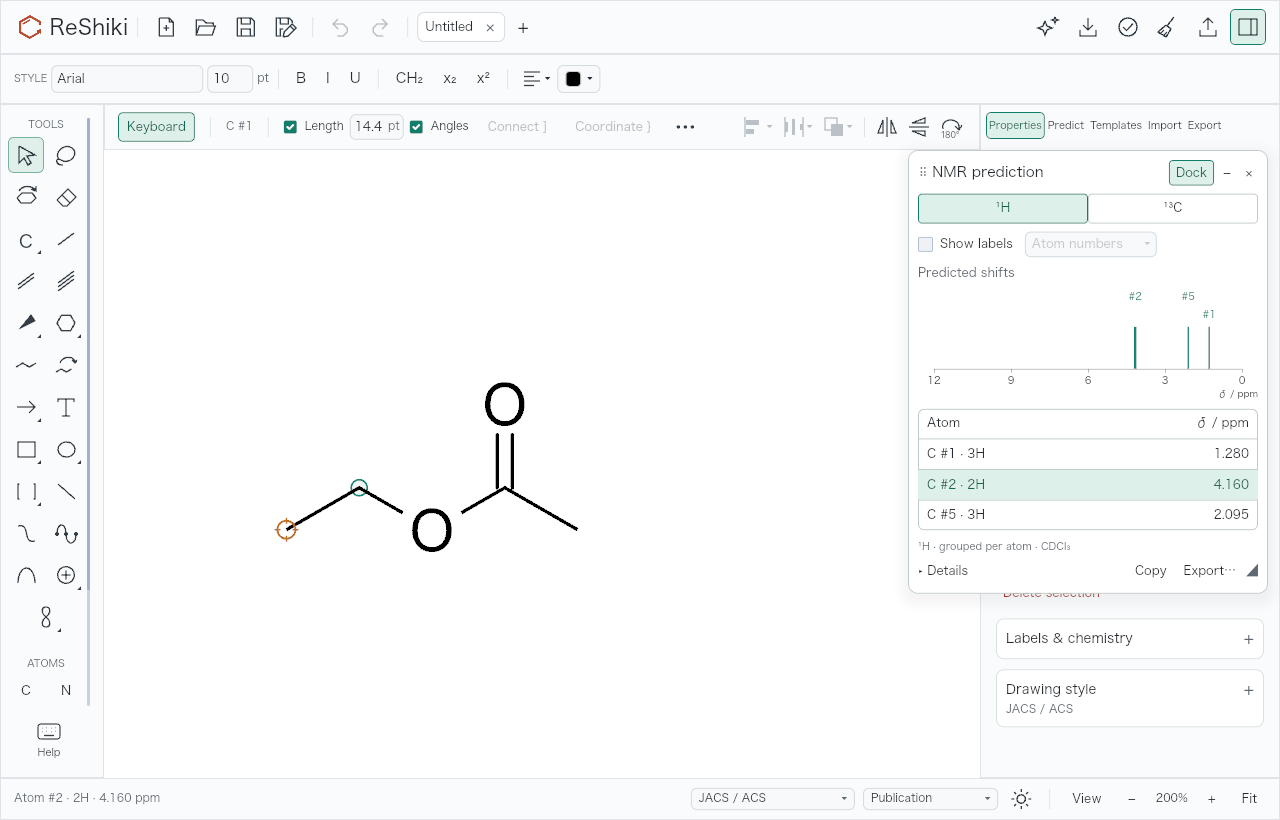
Move or dock the palette
Section titled “Move or dock the palette”- Drag the title to move the palette. Drag the corner glyph (◢) to resize it.
- Choose Dock to put the report in the inspector, under Predict → NMR. Undock returns it to the palette. Clicking the Predict tab also docks the report.
- − collapses the floating palette, and + expands it again. × closes the report.
- You can keep drawing while the report is open. Opening, moving or docking it never changes the zoom or the view.
Show the results on the drawing
Section titled “Show the results on the drawing”Turn on Show labels to write the results next to their atoms. The menu beside it offers Atom numbers (#3), ppm (1.280 ppm) or Both (#3 · 1.280 ppm). The labels move with their atoms. They never appear in exports or the Undo history.
Check and keep the results
Section titled “Check and keep the results”▸ Details adds a line under each row, for example Shell 4 · 17 references · SD 0.064 ppm. It also shows the method, data version, conditions, limitations and data credit, and offers Hide plot / Show plot. In the floating palette it adds Reset position and the − / + size buttons.
Copy copies the shifts as tab-separated text. Export… saves the same text as a .tsv file. Both include the method, data version, conditions, limitations and data credit.
A chemical change clears the results and labels. Moving atoms or changing the drawing style keeps them. To predict another molecule, select it and choose Predict NMR… again.
What the numbers mean
Section titled “What the numbers mean”- Each value is the median of measured CDCl₃ shifts for atoms in similar environments.
- Shell is how far around the atom the match reaches. The number of references counts the reference molecules behind the value.
- SD is the spread of those reference values. It is not an error bar.
- A ¹H row such as
C #3 · 2His one value for all hydrogens on atom 3, not separate peaks. - Stick heights in the plot do not show intensity or integration. Couplings and multiplets are not predicted.
- Only hydrogens on carbon get a value. O–H, N–H and other exchangeable hydrogens do not.
- Some atoms show no value when there is too little reference data, and the row says why. In ethanol’s ¹H result, only the CH₃ group gets a value.
- E/Z isomers, relative configurations and stereoisomers get the same values.
- Molecules of up to 128 atoms of H, C, N, O, F, P, S, Cl, Br and I are supported. Charged molecules, radicals, metals and labels for less common isotopes, such as ²H or ¹³C, are not.