Coordination attachment: native desktop validation
Engineering notes and historical checks.
Merged, unreleased, in PR #283, addressing #246. Contribution: @Ameyanagi, project creator and maintainer. The coordination guide describes the supported donor/metal endpoints, keyboard action and interchange limits.
Connect donor atoms to metals in place, including chelate closure, while retaining charge, hydrogens and donor→metal direction. Projection-tip styling is a separate drawing operation; it does not assign complex stereochemistry.
Provenance and capture conditions
Section titled “Provenance and capture conditions”The preserved macOS arm64 applications compare baseline
51fa0991da2507bb00b27c1b420e807468de6423 with candidate
8fbf166cb9daad908d743cce71e6c6d73a819a47. The candidate is a locked development
build with no default features, preserved and ad-hoc signed independently of
the shared Cargo target. Its signed executable SHA-256 is
77654ac99707cf6e1fc46a4ccc1bd3e10db97d802827873864a4a6973c2f2611.
The bundle receipt and
source receipt record the exact source
commit, 1,065 source entrypoints and content hash. A packaging audit checked the
preserved signed executable hash again; no new build was performed.
Before implementation, a retained model/keyboard harness against unchanged baseline modules confirmed Co3+ covalent capacity zero, ordinary joining and keyboard rejection, and no document mutation. Its output is the initial behavior confirmation. The frozen-application native desktop comparisons below were replayed after implementation, on 2026-10-09; they are not described as pre-edit screenshots. Later documentation/evidence commits do not change the tested executable.
All new ReShiki captures are untouched 2560 × 1704 JPEGs, at 221%, JACS / ACS and Arial 10 pt, without drawing export, crop or retouching. F8 is off except the explicitly labeled keyboard controls. The baseline error retains its Move & attach panel; the corresponding candidate success shows whole-drawing Properties. Some later captures have additional tabs, modified-state indicators or deliberate selection controls. Native JSON checks below establish chemical and coordinate preservation separately from those UI differences. Earlier recovery-banner Dismiss affected memory only; fresh-process captures retain the banner, and no recovery draft files were deleted.
The capture receipt records the original image hashes/dimensions and new native-fixture hashes. Every image was inspected for legibility and unrelated/private content before packaging.
Ordinary rejection and the matching donor-10 contact
Section titled “Ordinary rejection and the matching donor-10 contact”Open the same original native drawing in each application. It contains Co1 with charge +3 and three complete NCCN ligands: 13 atoms, nine covalent bonds, C6H24CoN6+3.
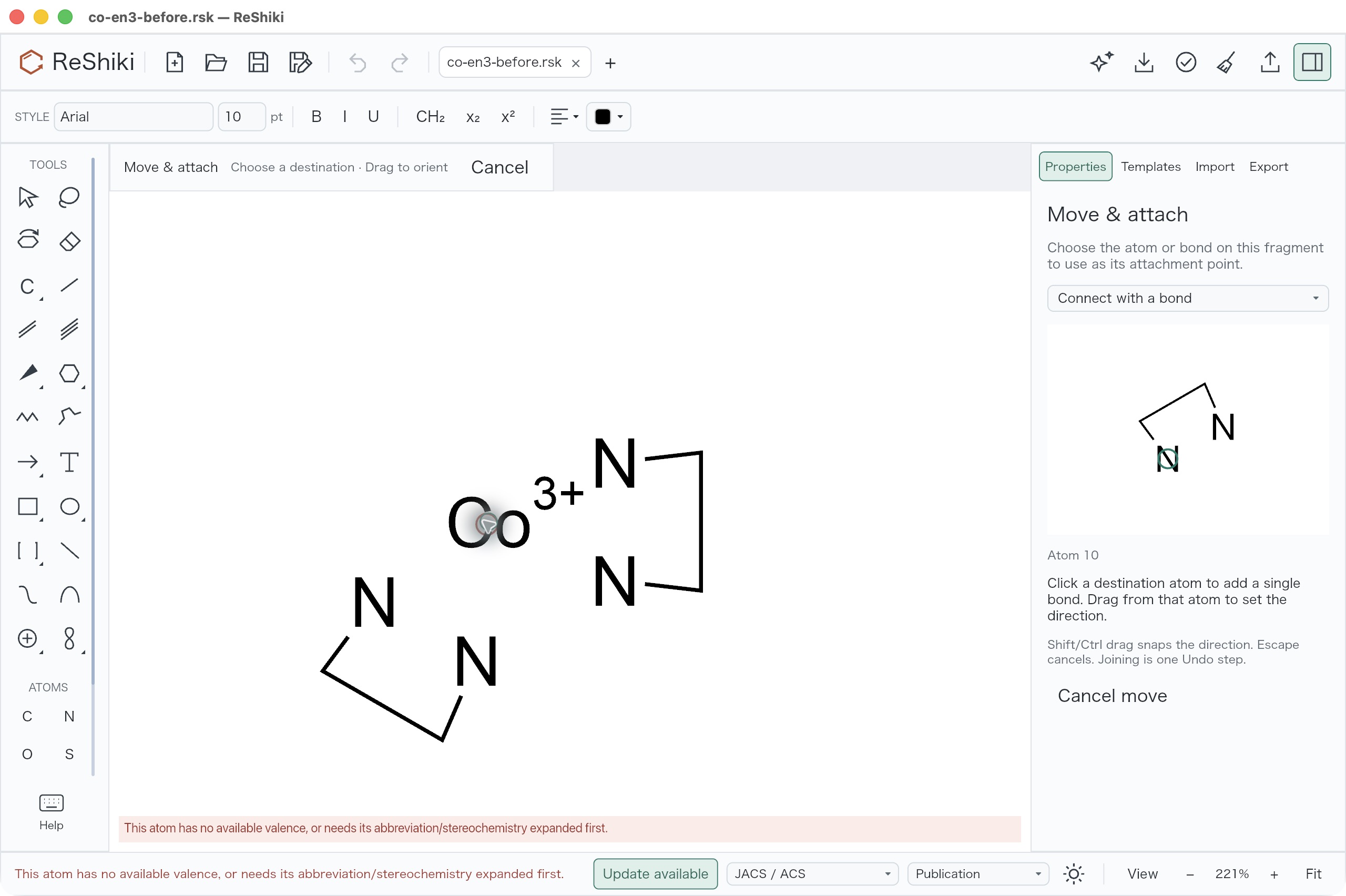
In the baseline, the operator initially selected upper donor 13 on the canvas, but ordinary Move & attach’s preview chose Atom 10 as its source anchor. Clicking Co1 gave no available valence; Escape left the original unchanged with no Undo entry. This distinction is visible in the panel and matters when matching the candidate: the candidate replay starts from a fresh original and explicitly adds donor 10 → Co1 using Coordinate in place….
| Baseline: ordinary Connect, panel anchor 10, rejected | Candidate: explicit donor 10 → Co1 succeeds |
|---|---|
 |
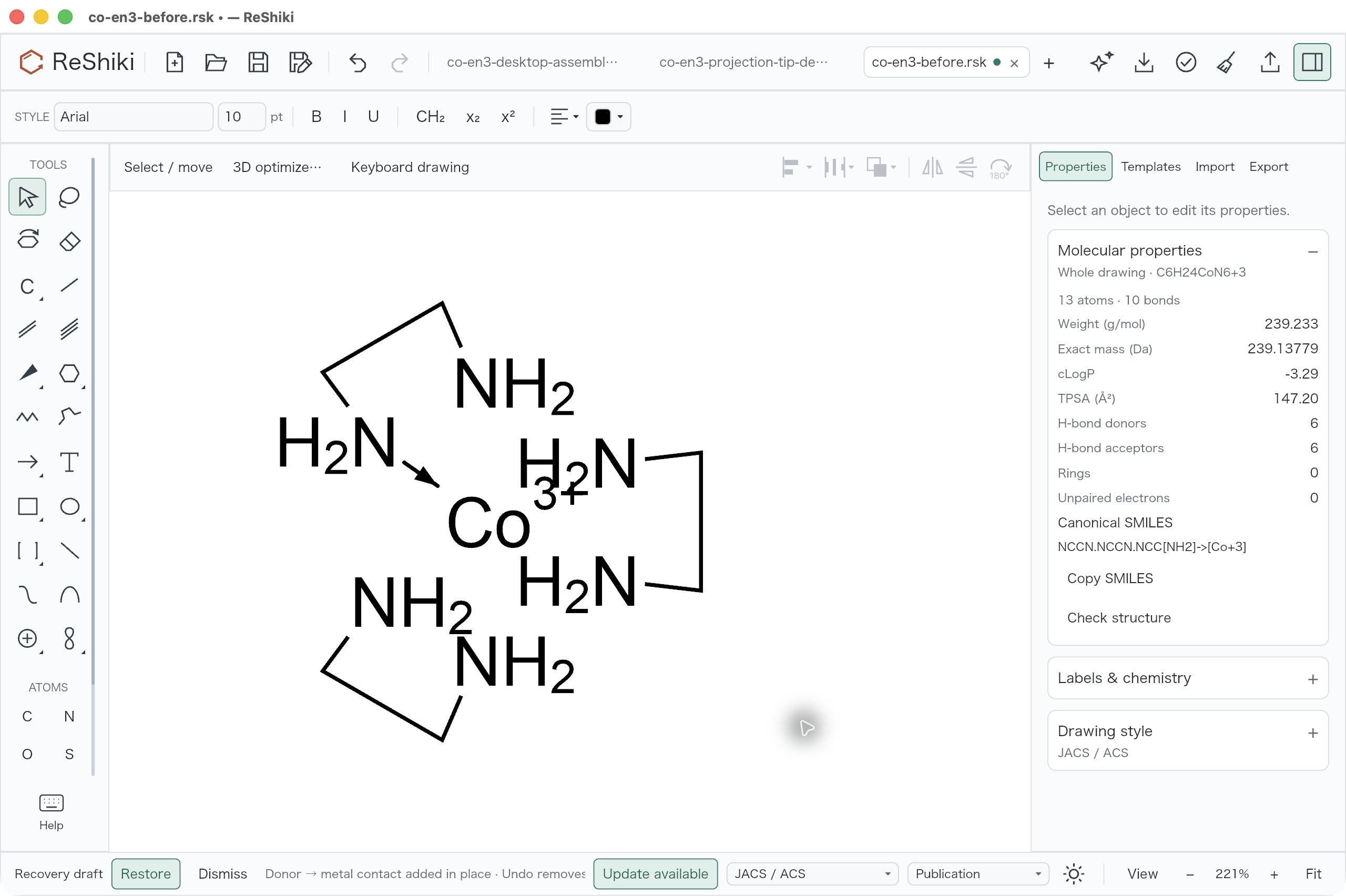 |
The one-contact native save contains exactly one new directed order-5 bond, 10 → 1, with plain dative appearance and no stereo. The independent one-contact audit confirms all 13 atom IDs, XYZ and every non-derived atom field exactly match the input; the original nine covalent bond records are unchanged. All coordinates are finite. Co charge +3 and all six nitrogen H2 labels remain unchanged.
Only the six carbon-derived H-label cache values refresh from 0 to 2, at IDs
3/4/7/8/11/12. Those caches are distinct from the unchanged explicit_h,
no_implicit, charge, isotope, aromatic and stereo fields. See the model’s
derived-label refresh. The same
cache update occurs in the complete desktop assembly and is not extra hydrogen
atom insertion.
Complete chelates, duplicate no-op, Undo/Redo and reopen
Section titled “Complete chelates, duplicate no-op, Undo/Redo and reopen”A separate fresh original was assembled with contacts from donors 13, 10, 2, 5, 6 and 9 to Co1, in that order. The second contact, 10 → 1, closes a chelate already in the same connected component; atoms stay in place. The result has 13 atoms and 15 bonds, retaining all three NCCN skeletons, six NH2 donors and C6H24CoN6+3.
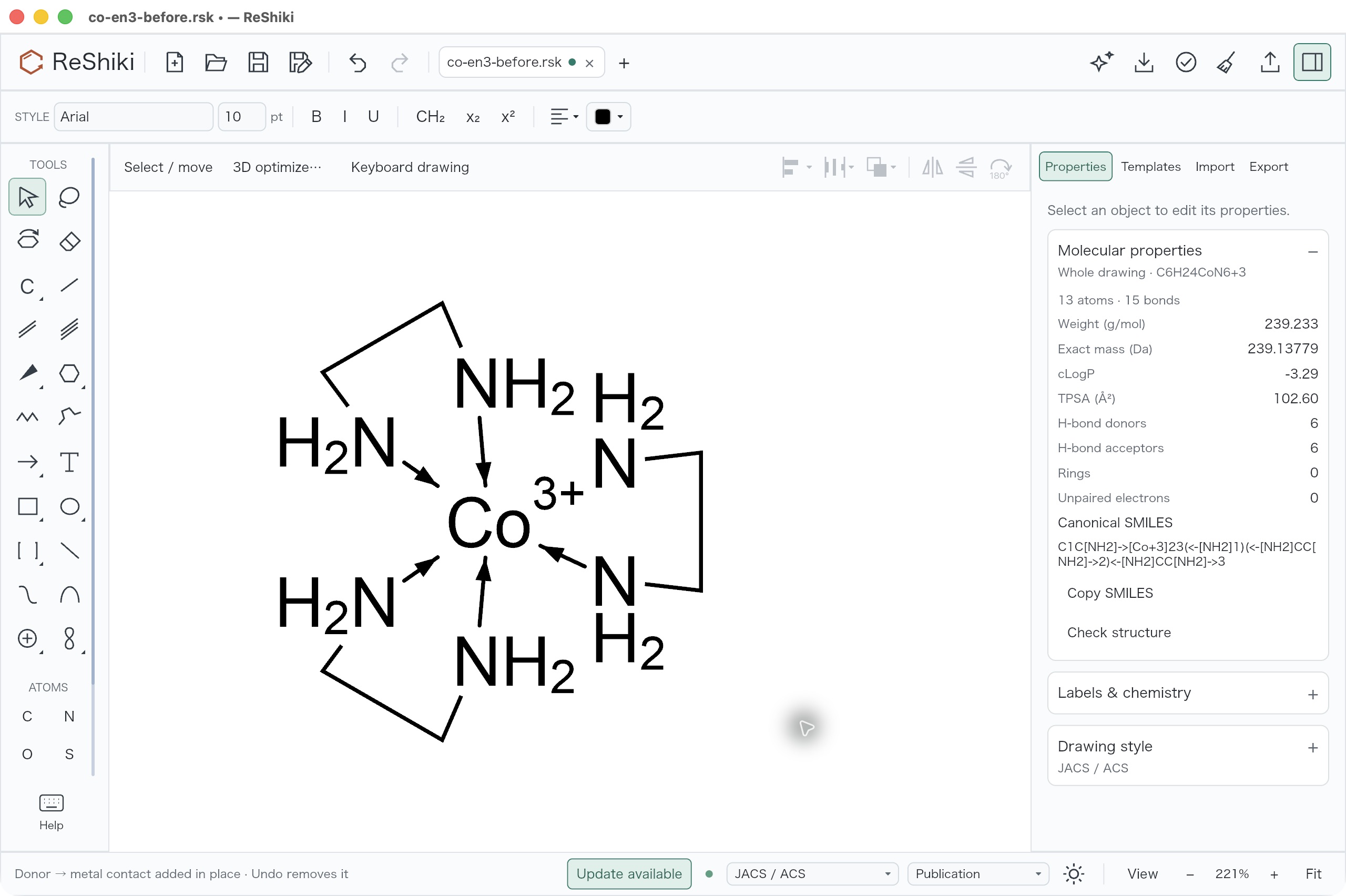
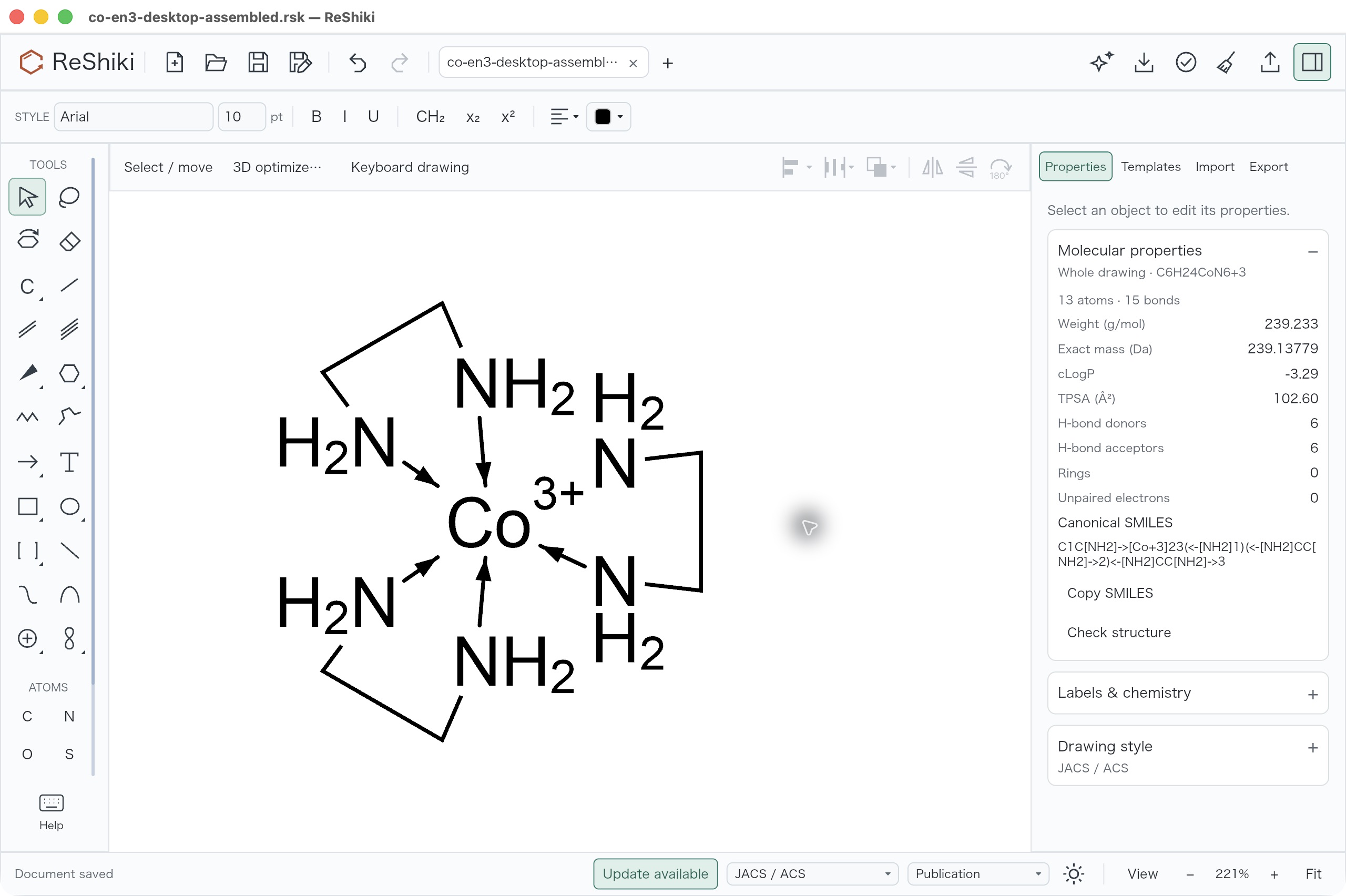
Repeating 13 → 1 made no edit. One header Undo then removed the previous actual contact, changing 15 bonds to 14; this proves the duplicate did not add another Undo entry. Redo restored 15 bonds. Save As produced co-en3-desktop-assembled.rsk.
| Saved desktop assembly | Reopened in a fresh process |
|---|---|
 |
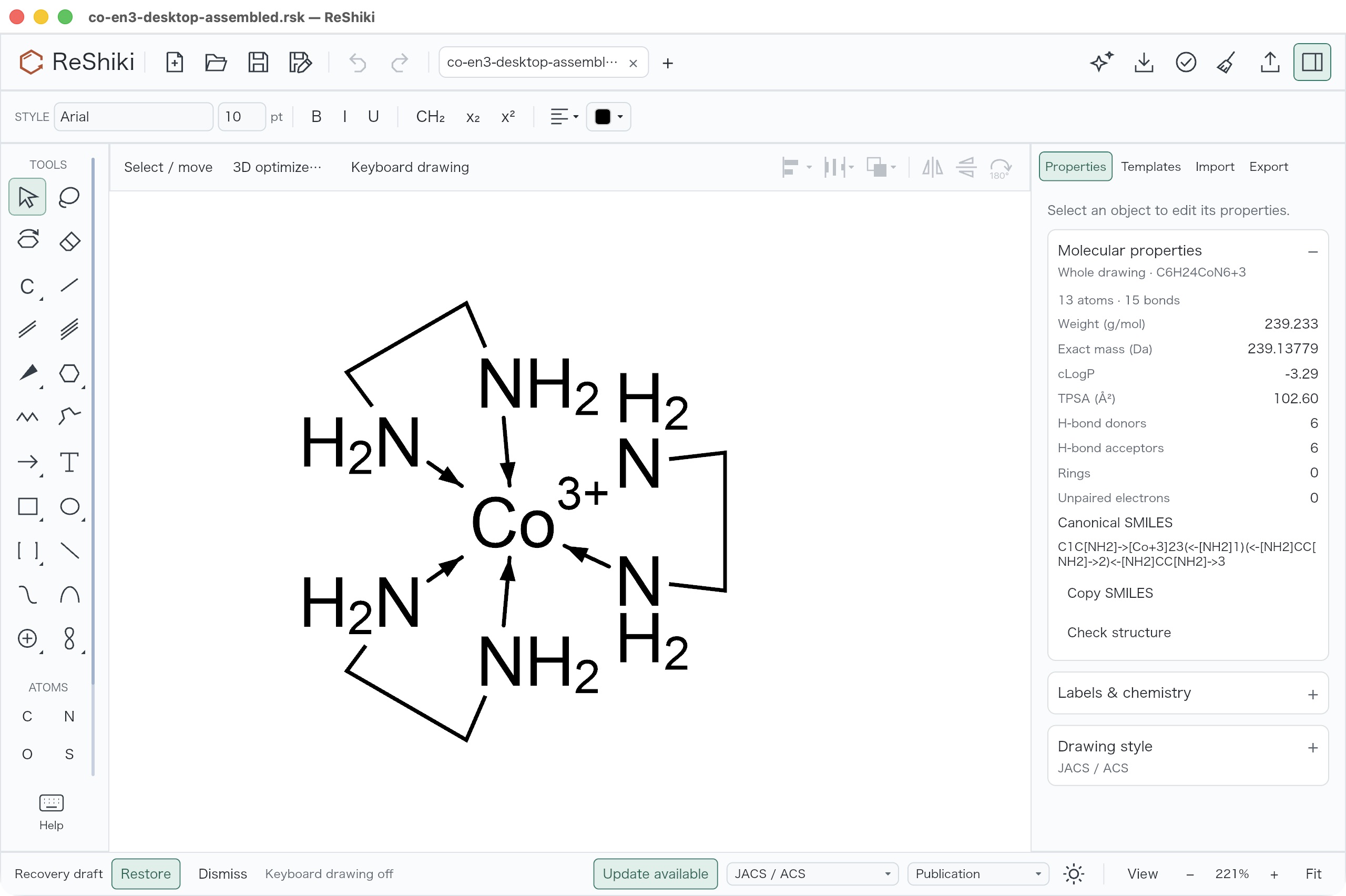 |
The retained independent audit confirms that all six new bonds are directed order 5 from donors 2/5/6/9/10/13 to metal 1. All atom IDs, XYZ and chemical metadata are unchanged apart from the derived carbon-label cache noted above; all original covalent bond records are exact. The fresh reopened file has a clean title and Undo disabled, so persistence is demonstrated independently of the prior process’s editing history.
Marked keyboard donor: [ and } versus ordinary ]
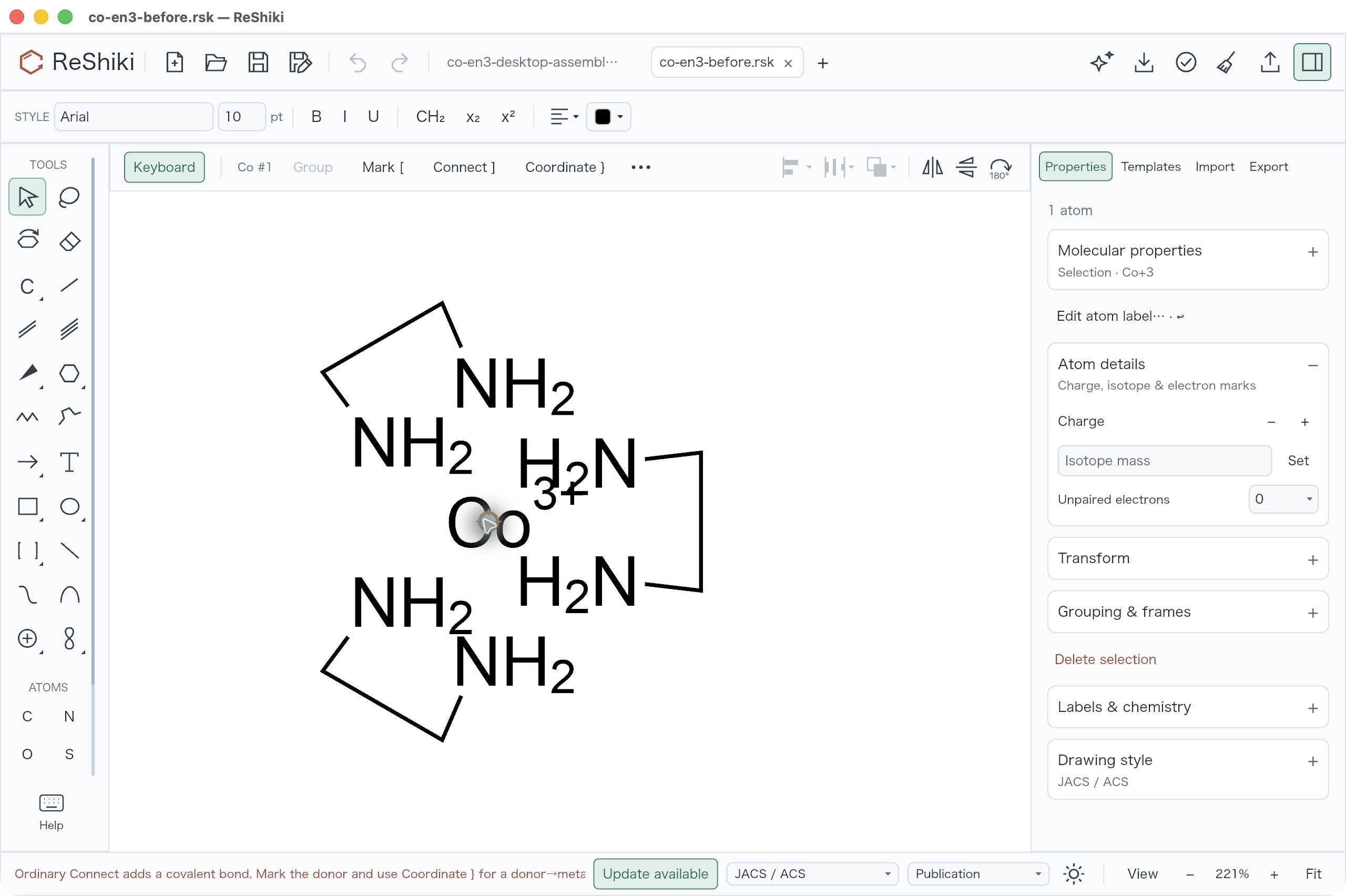
Section titled “Marked keyboard donor: [ and } versus ordinary ]”On another fresh original in the candidate, activate donor N5 with F8 on, enter [ to mark it, click Co1, and enter ]. Ordinary Connect rejects the covalent operation without creating an Undo entry. Entering } then adds the directed 5 → 1 contact, with one actual Undo step. On a US keyboard, } is Shift+]; other keyboard layouts must produce the } character. The labeled Mark [, Connect ] and Coordinate } controls show the donor/metal target context. These are two controls in the candidate application, not a frozen-base keyboard screenshot comparison.
| Candidate ordinary ] rejects covalent attachment | Candidate } adds the marked donor contact |
|---|---|
 |
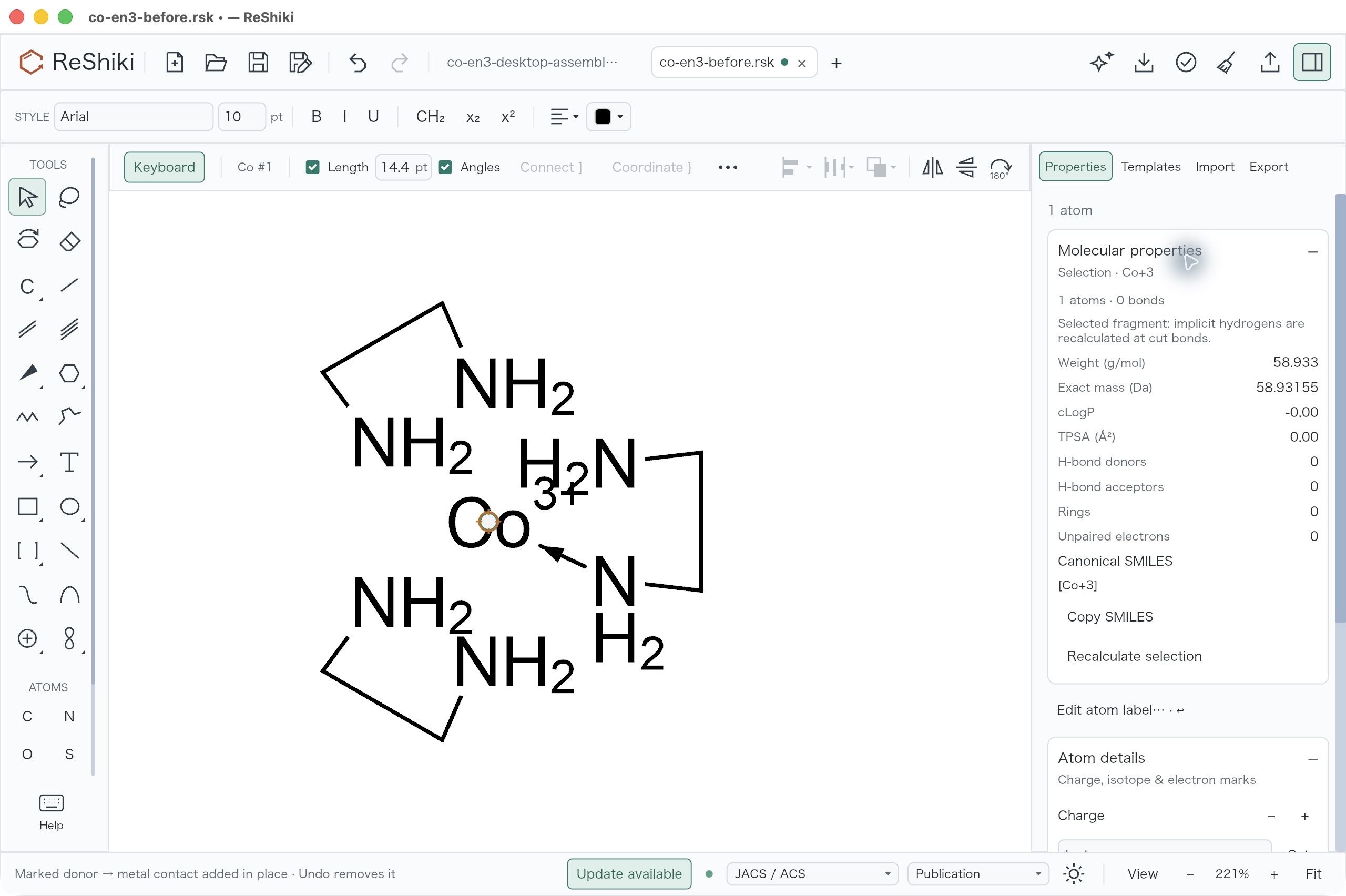 |
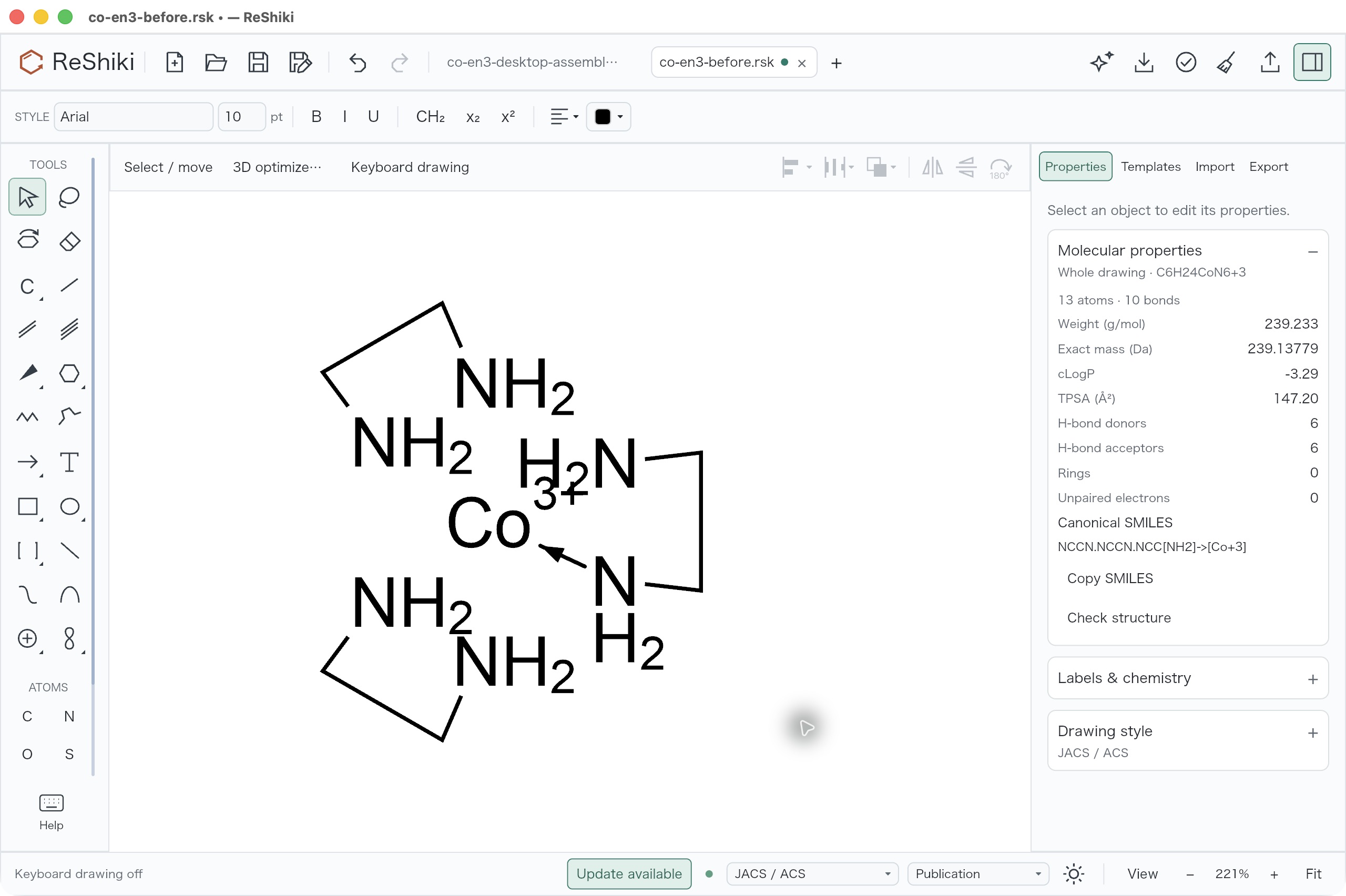
The success inspector above is Selection · Co+3 · 1 atom · 0 bonds; those numbers are not the complete drawing. After clearing selection and turning F8 off, the separate whole-drawing view reports 13 atoms, 10 bonds and the same C6H24CoN6+3 formula. The native result is co-en3-keyboard-desktop.rsk.
Projection tip changes paint, not donor direction
Section titled “Projection tip changes paint, not donor direction”Open the existing single-complex co-en3-both-tips.rsk, 13 atoms/15 bonds, at 221% with F8 off. Solid and hashed projection paint can be narrowed at donor or metal while chemical donor→Co direction remains fixed. This is not the external two-complex, 26-atom CDXML fixture.
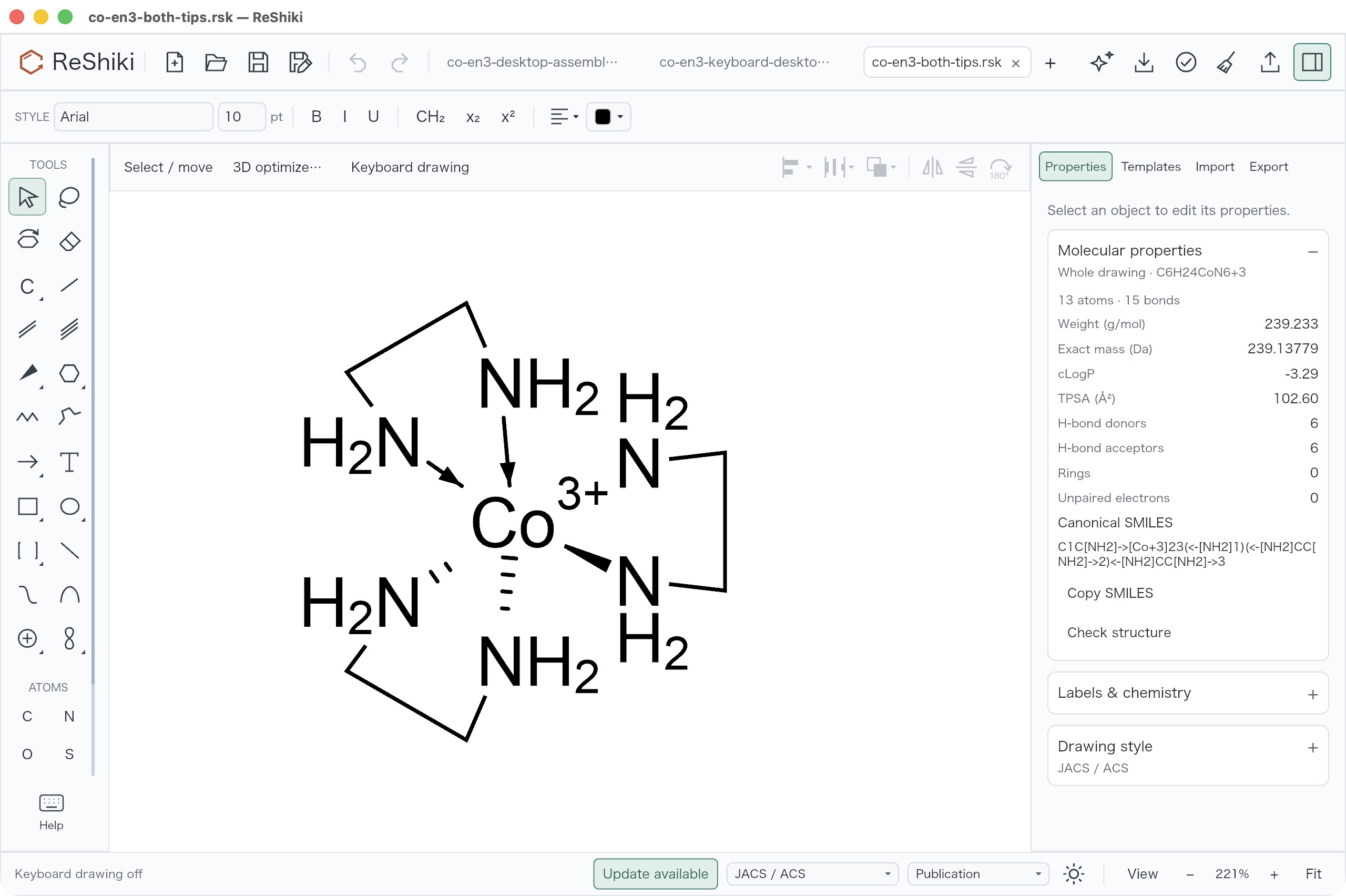
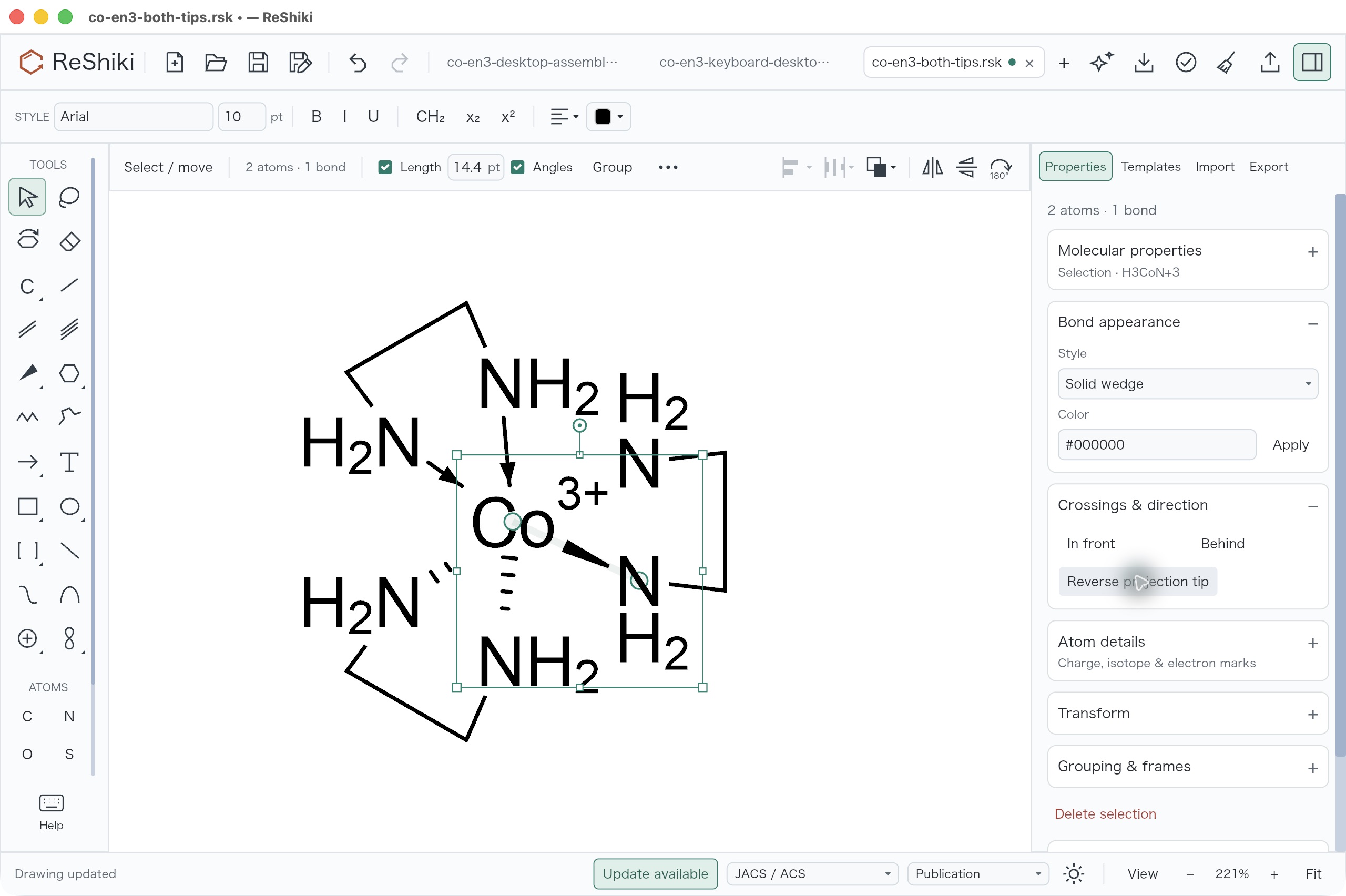
Select the solid projected 5 → 1 bond and choose Reverse projection tip under Crossings & direction. The selected-bond capture deliberately shows this control and selection handles. Save As produced co-en3-projection-tip-desktop.rsk, then a fresh process reopened it with a clean title and Undo disabled.
| Reverse projection tip on the selected bond | Saved result reopened, selection cleared |
|---|---|
 |
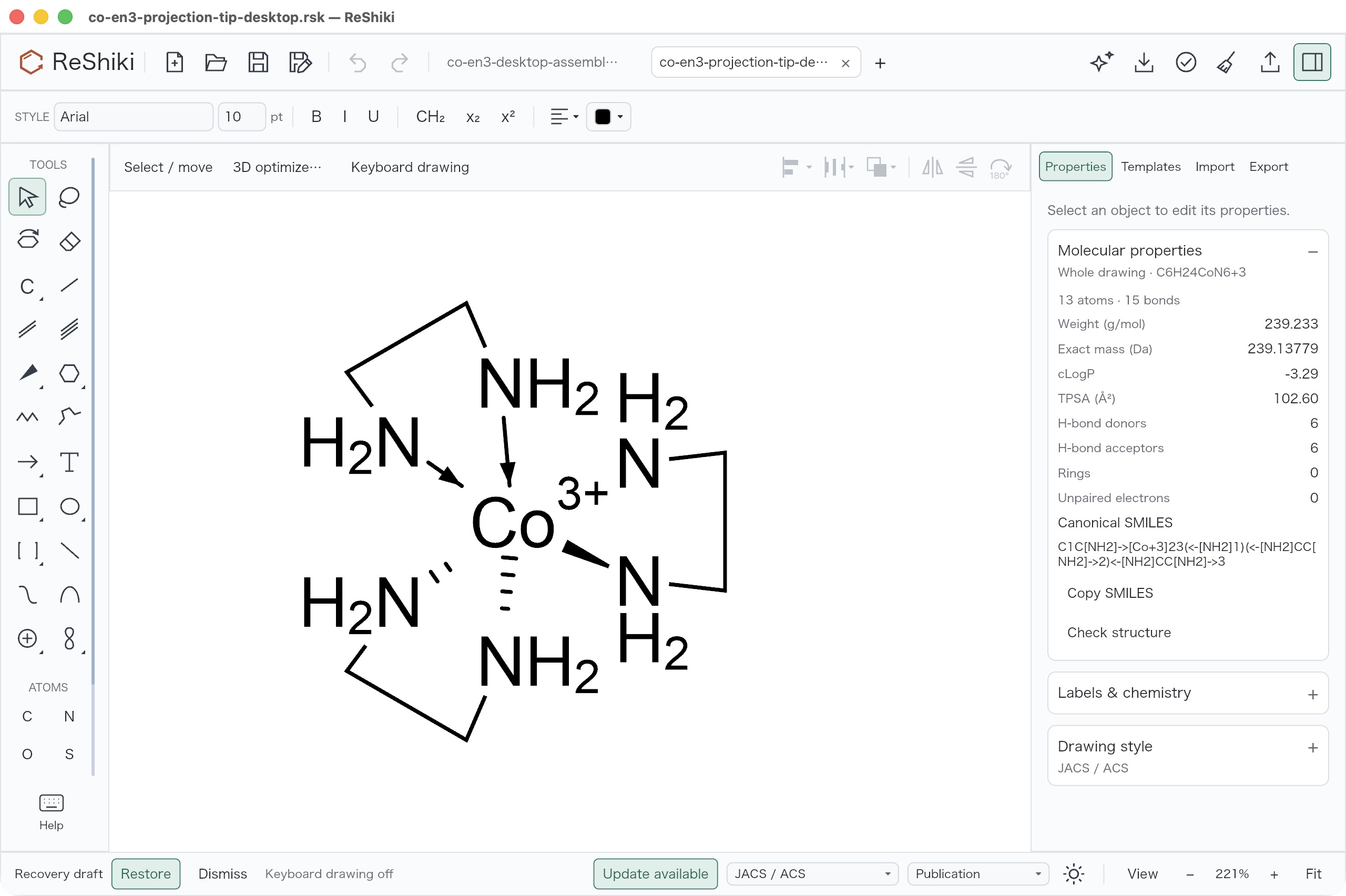 |
The native audit compares the before and saved documents: only bond array
index 10’s display changes from wedge_end to wedge. Its endpoints stay
a = 5, b = 1, order stays 5, all atoms and all other bond fields stay
exact, and no chemical stereo is assigned. Appearance alone is not used to
prove these invariants.
External ChemDraw reference and interchange limits
Section titled “External ChemDraw reference and interchange limits”The original authored paired CDXML source contains two complete complexes, 26 atoms and 30 bonds, with twelve donor→Co dative contacts. It asks for opposite Begin/End projection styles. Actual ChemDraw 26.0.0.6599 displays dative arrows rather than that paint:
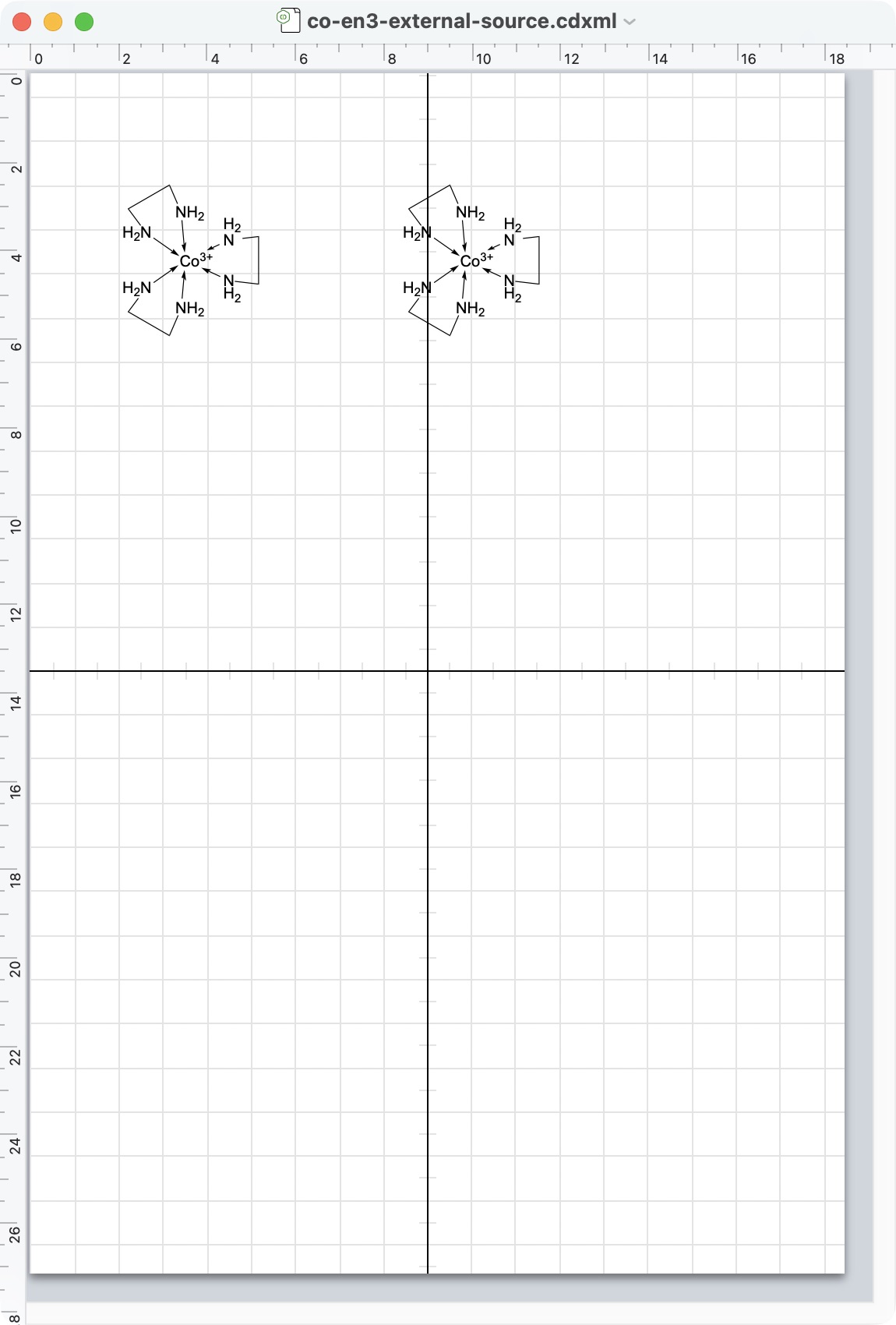
This unchanged reference JPEG is 1150 × 1700, with ChemDraw’s own page framing;
its original .png filename contained JPEG bytes, so packaging only renames
the extension. It is a separate external reference, not a matched ReShiki scale
comparison. The actual
ChemDraw Save As roundtrip
retains all 26 atoms, 30 bonds, twelve directed dative B→E contacts, Co charge
+3 and all N H2 values, but removes every dative projection Display attribute.
The XML contract check
records that measured distinction. No external projection-paint fidelity is
claimed.
Native and ReShiki CDXML/CDX roundtrips retain supported direction and projection attributes. Export warns about ChemDraw redraw/paint loss. MOL V3000 type 9 retains directed dative chemistry but omits projection paint with a warning. Earlier VERSION 19 parsers accept a plain dative control and safely reject the new end-tip styles as unsupported appearance; the retained executable control demonstrates refusal, rather than silent endpoint reversal or covalent stereo. Use native ReShiki or figure export when projection paint must remain faithful.
Recorded checks and scope
Section titled “Recorded checks and scope”At the tested source, full model tests passed 137, with seven existing opt-in cases ignored; full IO passed 95, with five opt-in cases ignored, using the built own-source app as InChI helper. App joining passed 7 and keyboard passed 18, with one opt-in renderer case ignored. Strict all-target app/model/IO Clippy, formatting, diff checks and the locked app build passed. The IO Begin/End style matrix was additionally rechecked with focused tests and strict Clippy. Tests cover donor graph/H/charge/stereo, same-component closure, duplicate/Escape/Undo, solid/hashed/hollow tips at each endpoint, tapered render geometry, crossing clearance, clipboard and supported format roundtrips.
The preserved executable analyzed the complete native fixture as valid, C6H24CoN6+3, and rendered the projection figure. Its InChI/InChIKey fields are empty for this coordination graph, so they are not used as identity proof. Native interaction checks above are macOS only and were not timed with a stopwatch. No source/test code, existing fixture bytes, solver run or new Cargo build changed during this documentation packaging. Original fixtures and captured evidence are identified in the fixture README; existing component notices remain in NOTICE.
Archived evidence
Section titled “Archived evidence”The historical evidence cited in this record is preserved in docs/fixtures/coordination on the evidence archive branch.
| Archived files | What they record |
|---|---|
| docs/fixtures/coordination | Bundle/source/capture provenance, one-contact and assembled-complex audits, XML comparison and older-reader refusal output. |