Reaction atom maps: native validation
Engineering notes and historical checks.
Imported atom maps were already retained in reaction chemistry, but their
numbers did not appear on the drawing. This change derives visible indicators
from map_num, keeps custom atom numbers independent, and adds manual map
editing, reviewed automatic correspondence and a separate rigid alignment
command. See the usage guide.
This record covers the October 10, 2026 native macOS checks and focused tests. It does not claim general reaction-mechanism inference or comprehensive mapping accuracy across a reaction database.
Imported maps: actual before and after
Section titled “Imported maps: actual before and after”The controlled input is
[CH3:1][OH:2]>O>[CH2:1]=[O:2].
The old app imported it and saved
native-before.rsk. Its five
atoms, two bonds, one reaction and maps [0, 1, 1, 2, 2] were already correct;
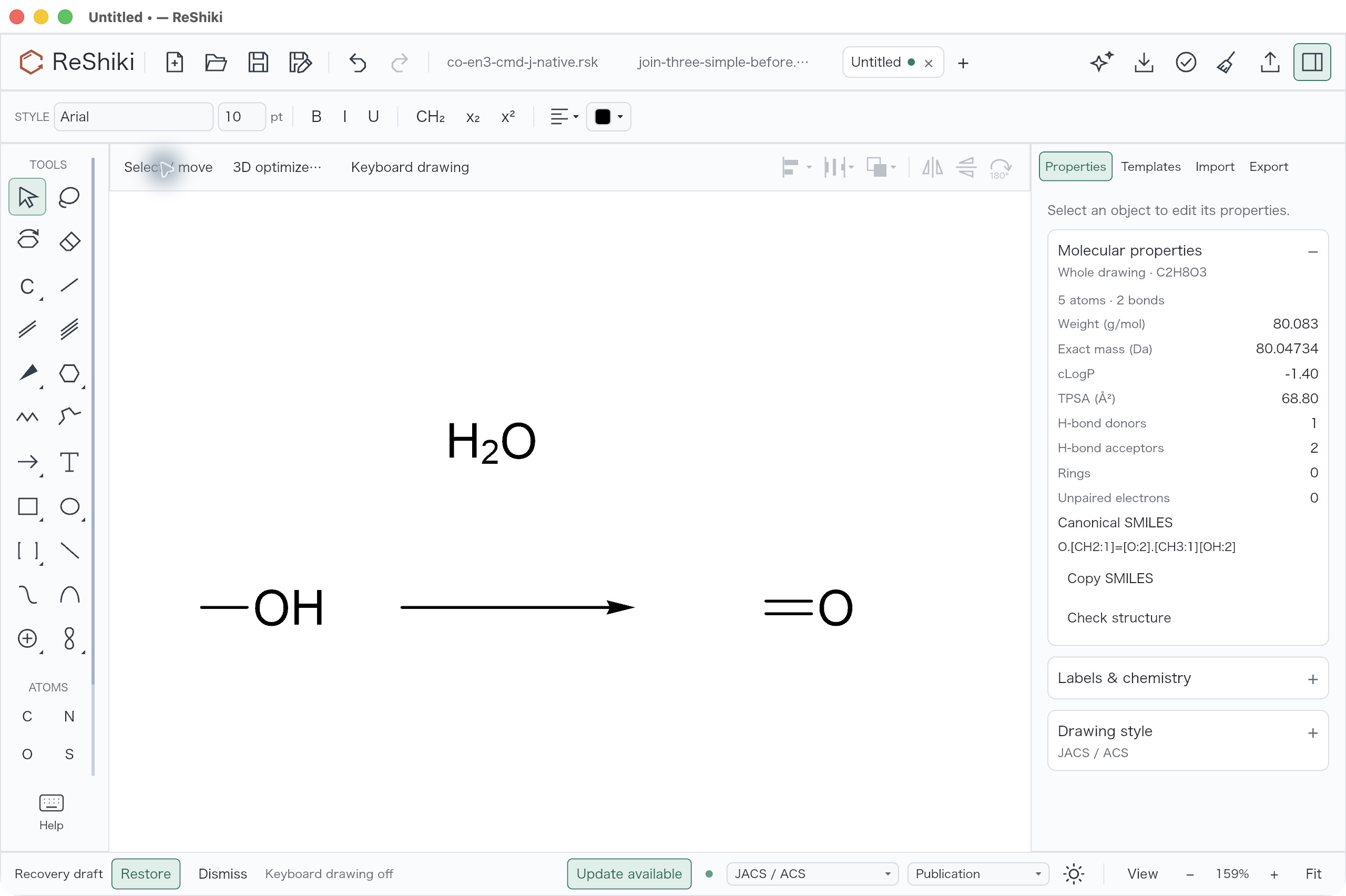
the water agent was unmapped. The verified new app opened that exact native
file unchanged, and all four positive maps became visible.
| Historical native import: maps absent from canvas | Verified new app: same saved chemical input |
|---|---|
 |
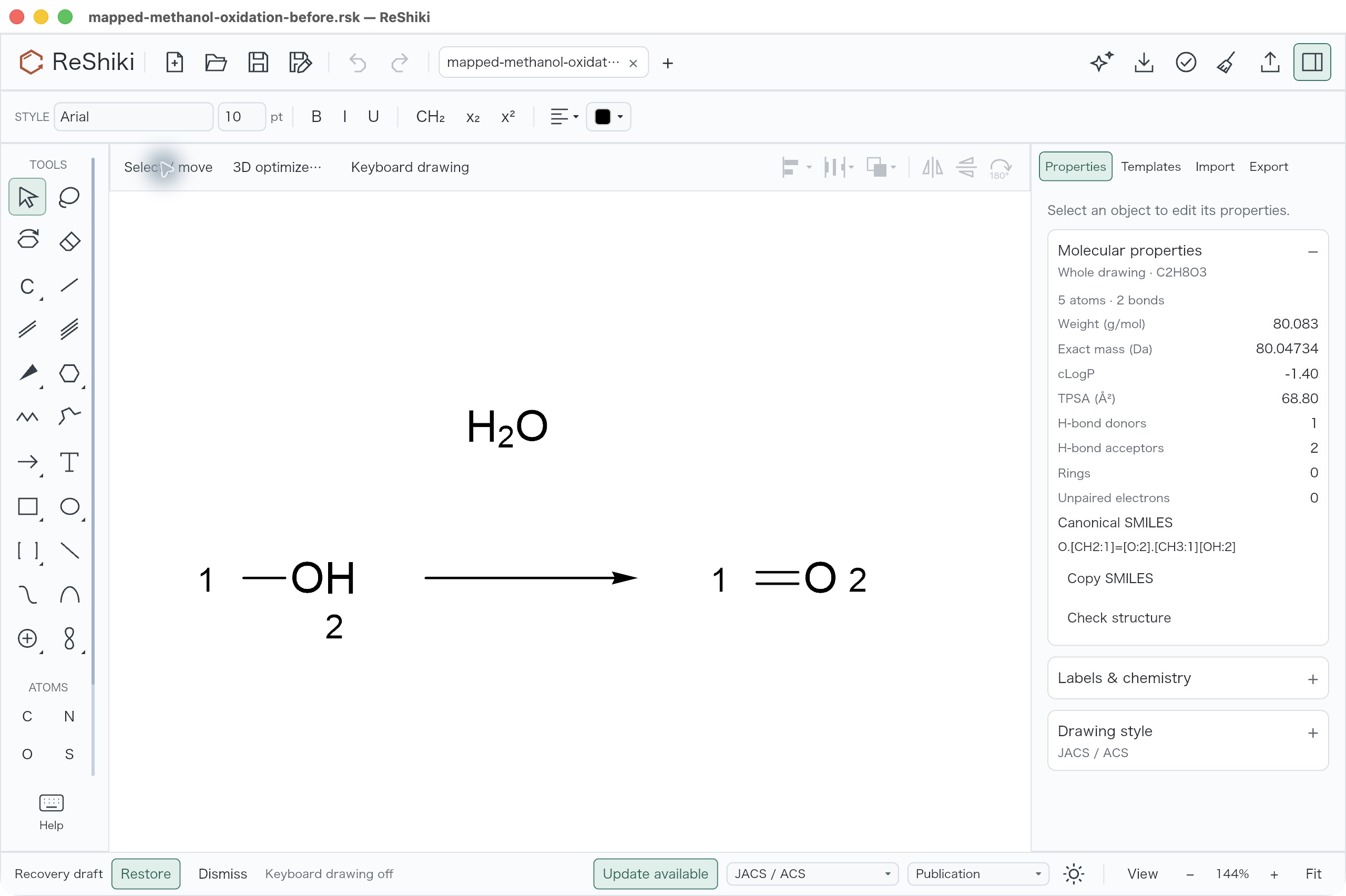 |
These are unedited native screenshots, not renderer fixtures. The old view is 159% zoom and the new view is 144%, with different framing. They demonstrate indicator visibility; they are not a pixel-matched geometry comparison. The native JSON verifies unchanged atom coordinates and chemistry.
The historical before app was ReShiki Coordination Join Verified, a
default-feature development snapshot based on 39b25cd plus its reviewed
shortcut patch. It was not the exact base of this branch. The new candidate
was built from 51fa0991da2507bb00b27c1b420e807468de6423 plus the frozen,
uncommitted mapping implementation on feat/reaction-atom-mapping. Mapping
import/model/indicator sources were checked against that base before editing.
Provenance records both
executable hashes and the exact capture/build distinctions; no final PR commit
is claimed for this development capture.
Native editing and proposal review
Section titled “Native editing and proposal review”Starting with the saved old native input, the operator:
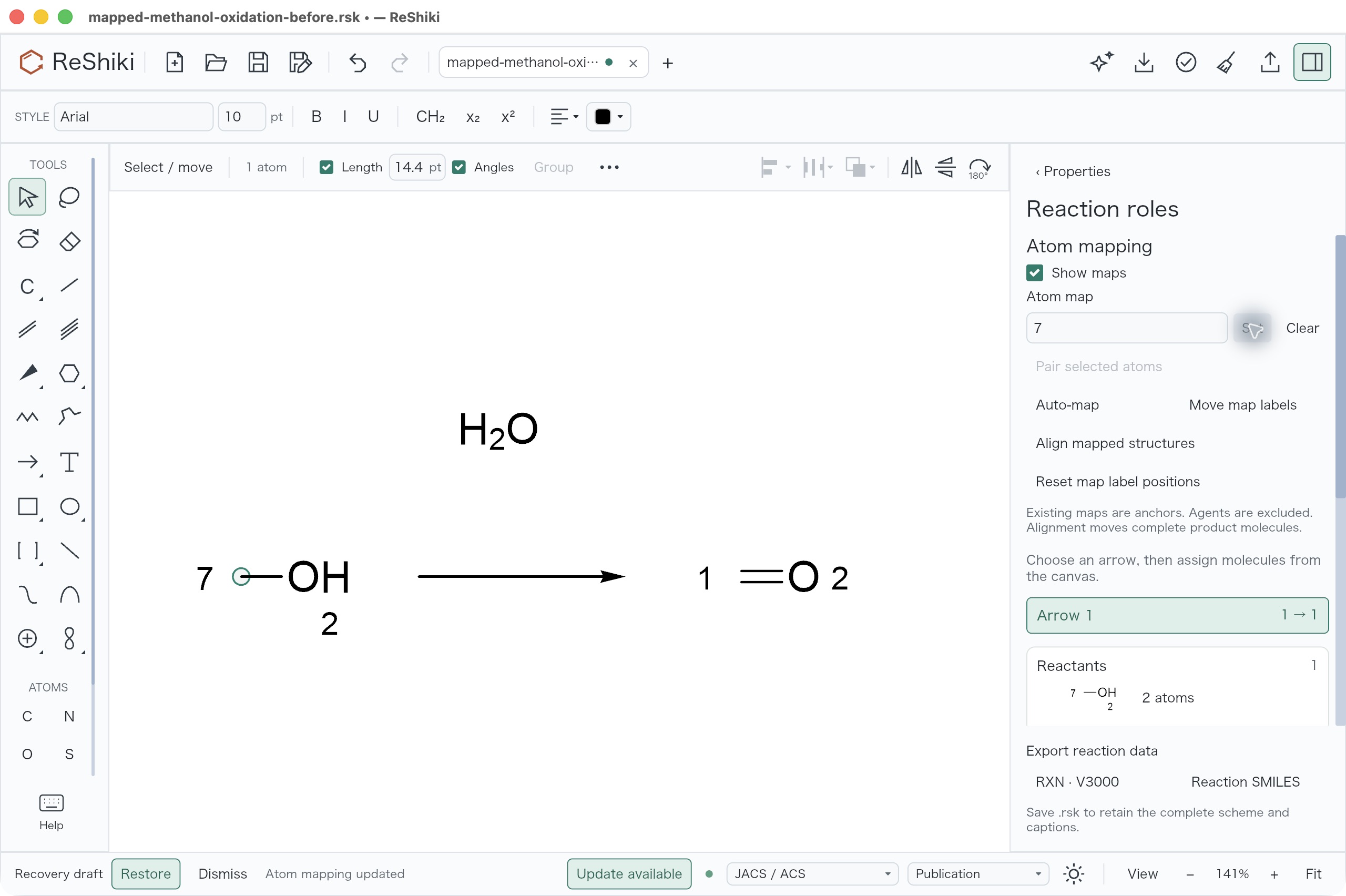
- Tried to set reactant carbon map 1 to 2. The duplicate-side error retained the drawing, clean state and empty Undo history.
- Set that carbon to 7, then used one Undo to restore 1.
- Cleared its map and ran Auto-map. The detached review showed two pairs,
C → CandO → O, zero unmatched atoms and one best mapping under the graph score. The main canvas carbon stayed unmapped before Apply. - Chose Apply reviewed proposal (now Apply maps). Carbon map 1 returned; one Undo removed it and Redo restored it. Show maps off/on changed the ink.
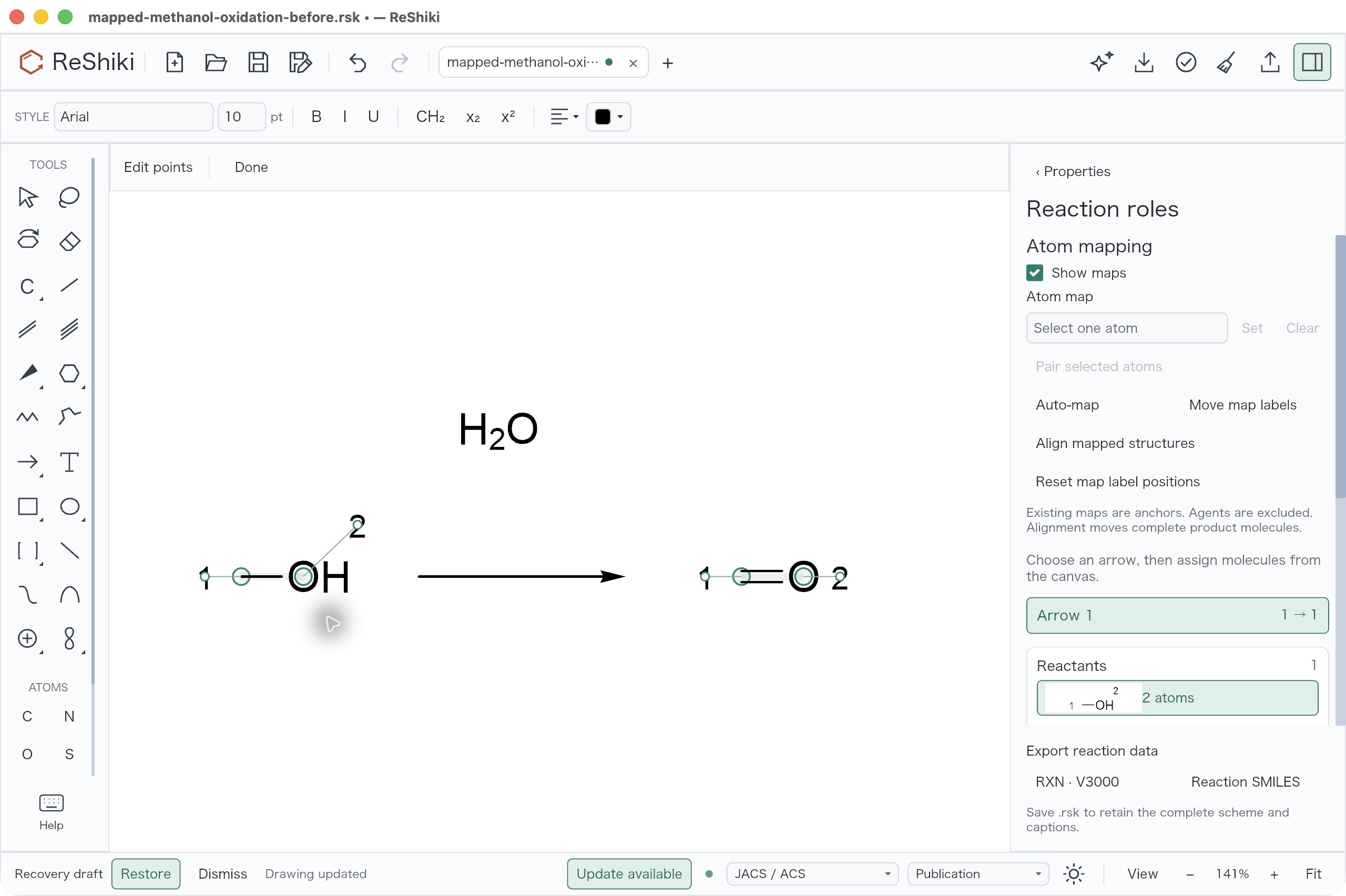
- Dragged reactant oxygen’s map 2 handle, used Undo/Redo, and saved the actual custom-label native result. Reset map label positions (now Reset label positions) restored automatic placement; Undo restored the custom placement. Closing the saved tab and opening its exact path in a fresh tab retained the custom offset, with Undo/Redo disabled.
| Manual map edit | Independent map-label placement |
|---|---|
 |
 |
| Detached proposal before Apply | Main drawing after reviewed Apply |
|---|---|
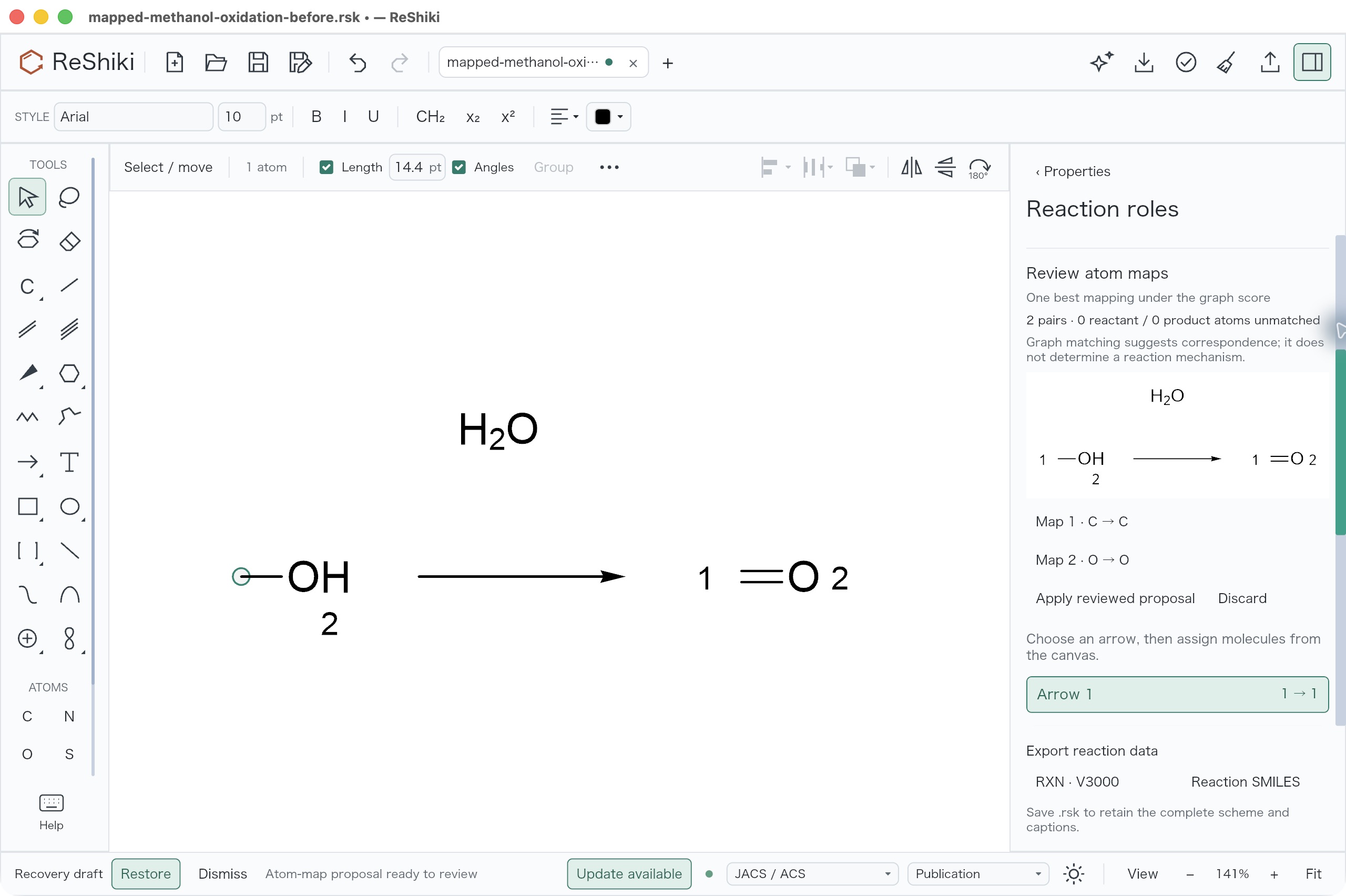 |
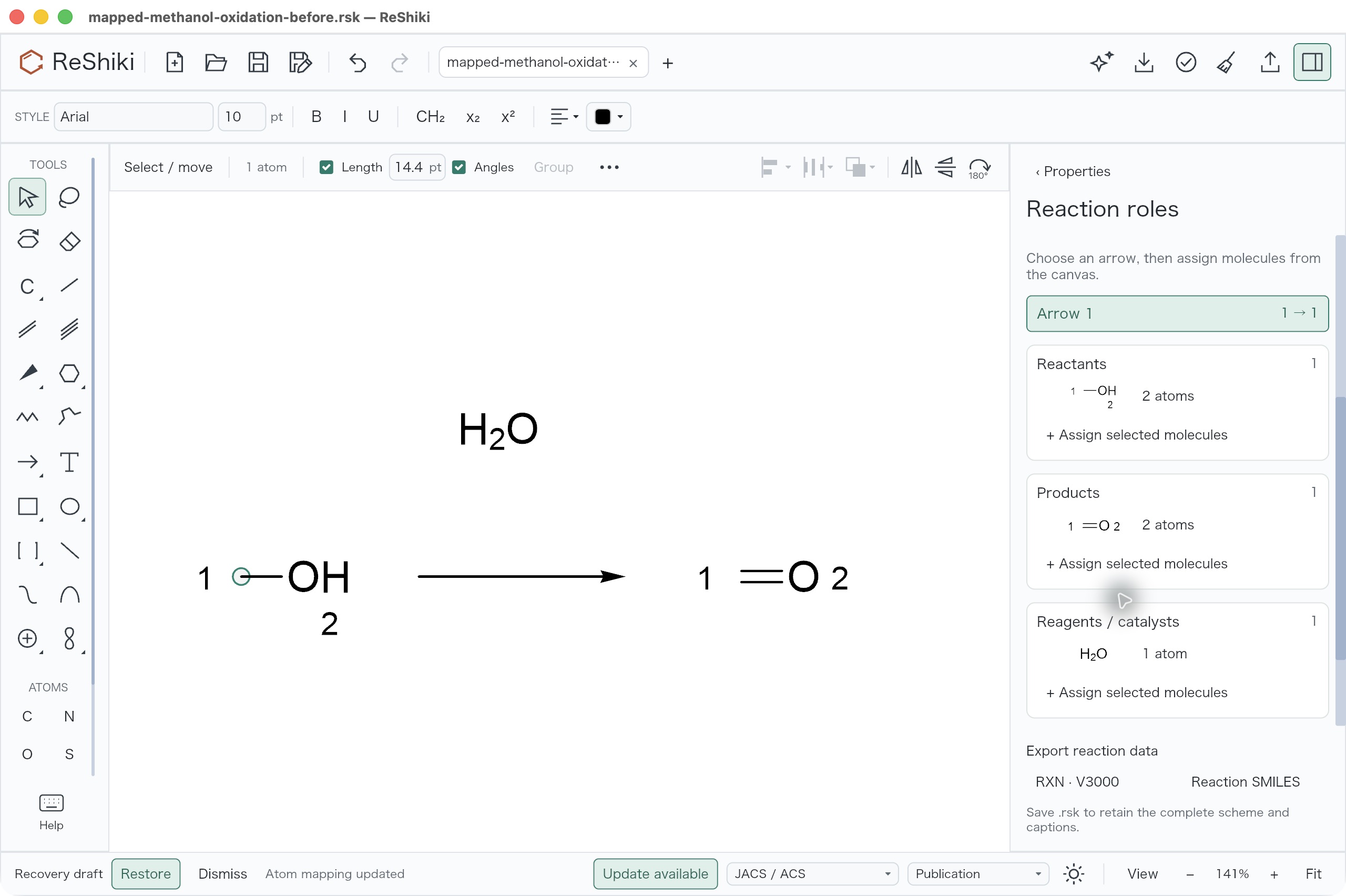 |
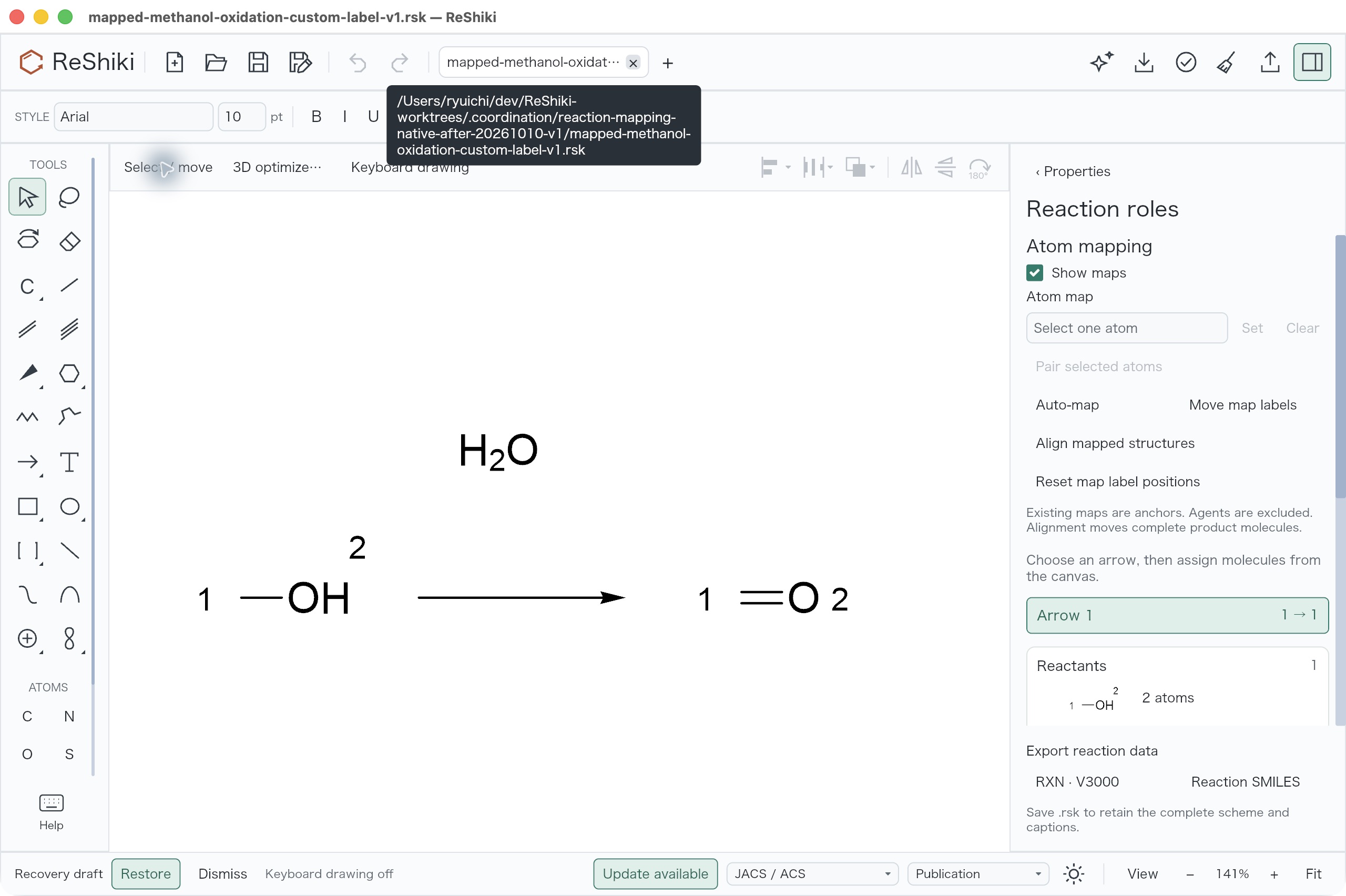
The actual custom-label save is 4,581 bytes, SHA-256
ce1c6c6aa0b00da79eb67226137f446b63584c347bd1010c7f90319d17379cdb.
Compared with the untouched old native save
6aa6549fe2f76c0fc3132d10393cf2941a5f27ffe927f133b60566da8e76301b,
its only raw difference is atom 2’s display record. After serde defaults are
normalized, only owner Mapping(2) gains offset
{x: 36.582657, y: -34.99306}. Every chemical/cache field, map, atom coordinate,
bond, role/coefficient, arrow, custom-number field and document setting is
unchanged. Label text remains derived from map 2; no custom text is substituted.
This was a same-process fresh-tab reopen, not a fresh-process restart.
Earlier accessibility captures often reported a diff or no change; only the
fresh-reopen full tree is used to confirm disabled Undo/Redo. A wrong-row Open
attempt produced an invalid-UTF8 error before the successful exact-path
retry; that attempt remains in the private immutable receipts. The map field
retains the previously typed draft 7 after Undo while the canvas map restores
1; the draft is not the chemical map value.
Proper rigid alignment: actual native save
Section titled “Proper rigid alignment: actual native save”The authored oxidation fixture
contains [CH3][CH2][OH]>>[CH3][CH]=O, maps 1/2/3, and an independent custom
number Cα. It is test-writer output, not a native save or external producer
return. The controlled input
changes only product IDs 5/6/7 coordinates by a proper +90° rotation about
their centroid. The verified app opened it, ran Align mapped structures,
then Undo/Redo and native Save As.
| Native controlled input, 130% zoom | Native Align result, 130% zoom |
|---|---|
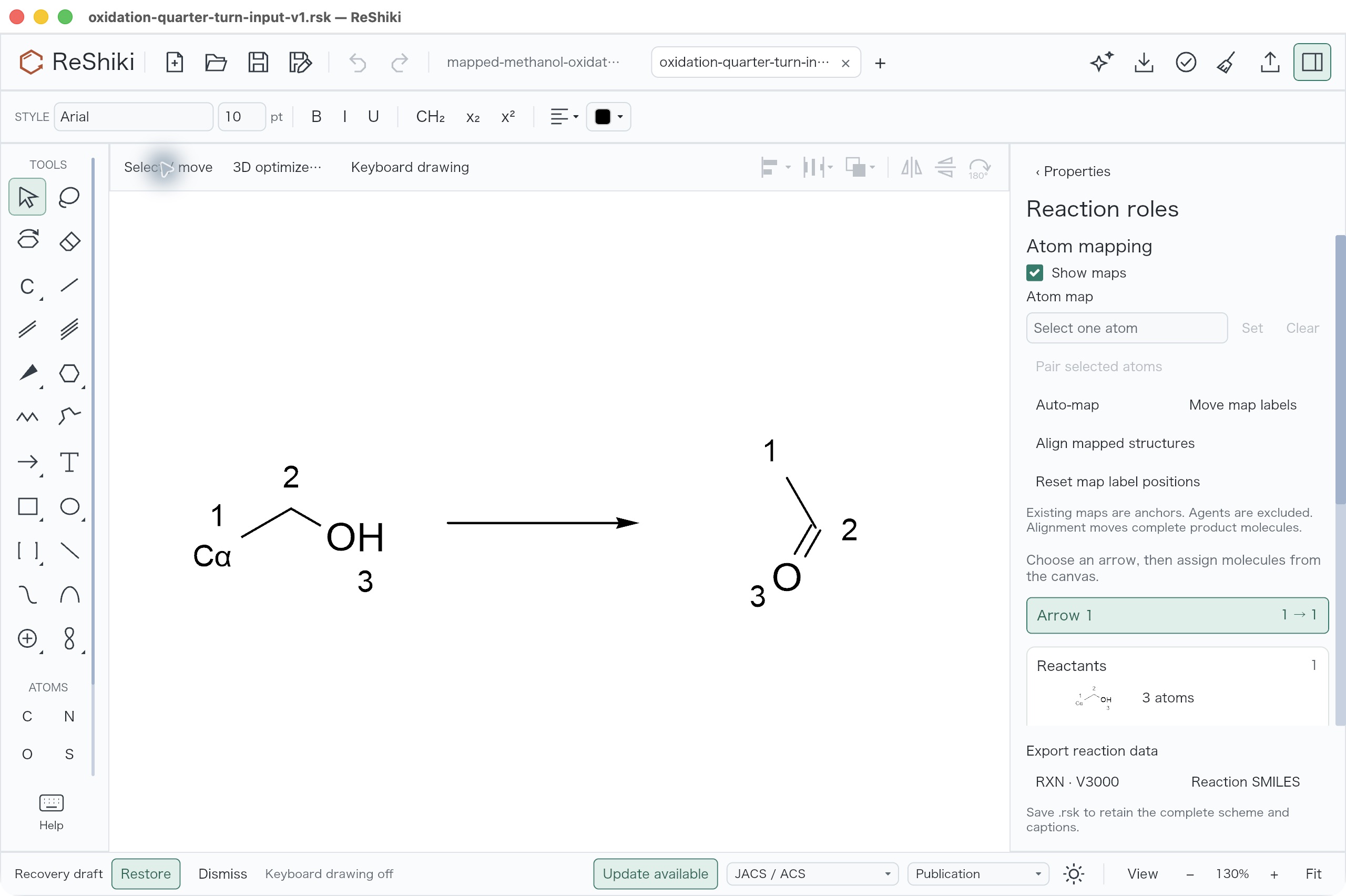 |
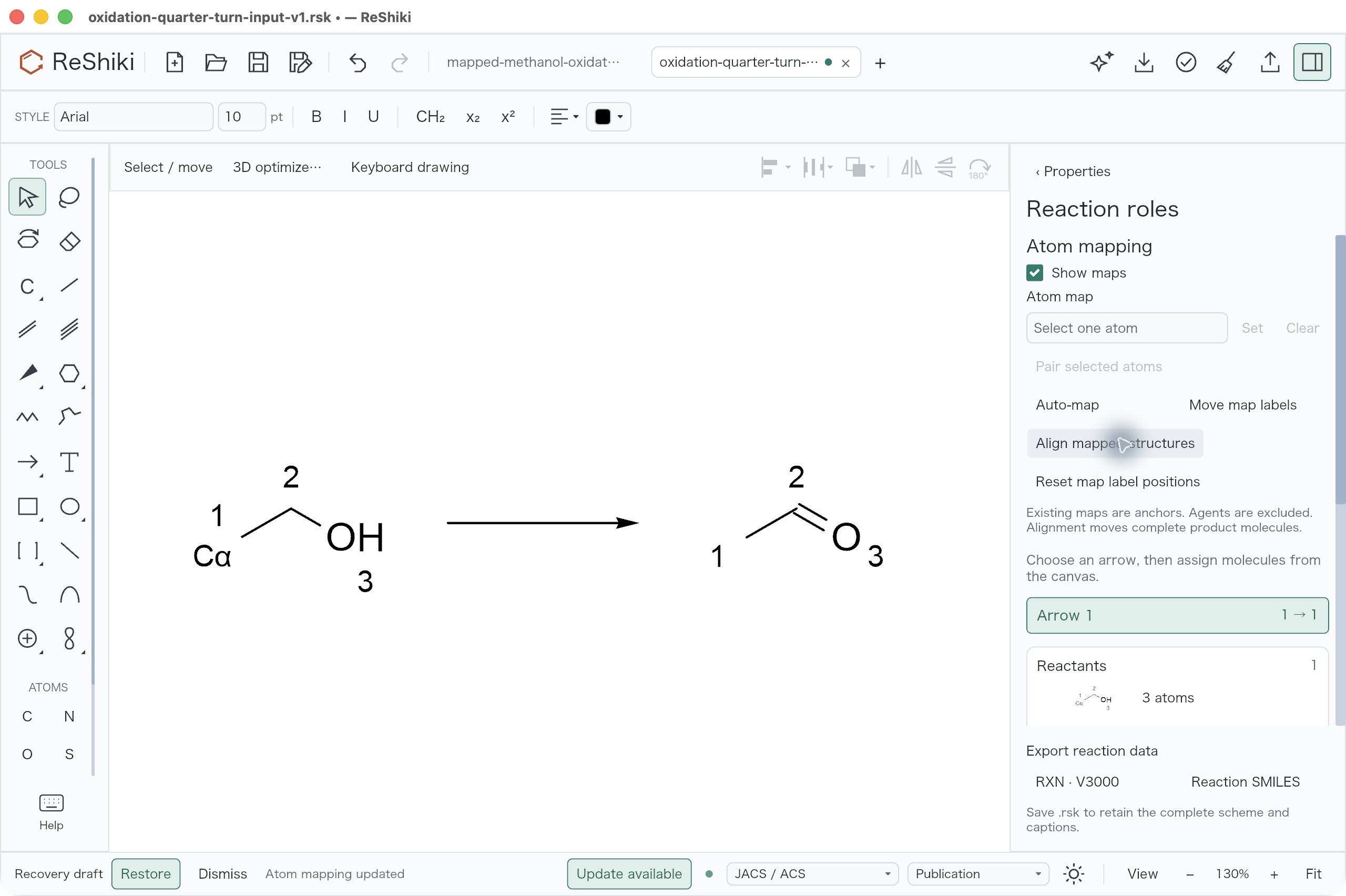 |
The actual native aligned save
is 4,685 bytes, SHA-256
d88fb3c0bf83bc0dffa7e68cf5deea447740d626fdc9cb7b58f6d65a0bb49239.
Against input
ed9c05c7c90adbae9ec66226c0b8cd59151cdd354724ba4f25fc9e5f7b780f72,
only those three product positions and document version 15→19 differ.
Document::file_json() already serializes current() with VERSION = 19;
this is existing native-save normalization, not a version bump by this feature.
The fitted product rotation is −89.9999923°, determinant +1, with maximum
rigid-fit residual 5.74×10⁻⁶ and maximum pair-distance change 1.0×10⁻⁵
drawing units. All three pair distances and oriented-area sign are preserved
within saved-coordinate precision. Mapped product vectors match the reactant
vectors with a common drawing-lane translation. Reactant positions, all
chemical/map/display/custom-number fields, bonds and roles are exact.
The native fixture is achiral and has one three-atom product. It does not establish native stereocenter or multiple-product coverage. The focused Rust test separately checks rigid stereo preservation. No alignment reopen in a fresh process was performed or claimed.
Portable verification and focused checks
Section titled “Portable verification and focused checks”This historical command uses archived verify.py; restore the cited evidence to a matching source checkout before running it with Python 3.9+ and no additional packages.
python3 -B docs/evidence/reaction-atom-mapping/verify.pyThe verifier checks the hashes of
all 15 copied images/data files, exact authored atoms/H/charge/isotope/maps,
bond orders, roles/coefficient/agent expectations, baseline coordinates,
custom-number ownership/style, the controlled +90° derivative and the native
proper rigid transform. It also rejects 11 semantic negative controls,
including correlated changes to both comparison files, wrong map-label owner,
overwritten Cα, a distance-preserving reflection, scaling and bond distortion.
Negative controls use in-memory copies and bypass artifact hashes so they test
semantic checks rather than merely detecting changed bytes. The script writes
no files and launches no application. Recorded result.
Focused default-feature checks passed on the frozen implementation:
| Check | Passed |
|---|---|
| Model search regressions: dative direction and budget precharge | 2 |
| Mapping integration fixtures | 11 |
| App mapping/history/stale-result regressions | 3 |
| Existing atom-label / reaction guards | 7 / 3 |
| Explicit disposable fixture writer | 1 |
Strict model/IO and app Clippy checks passed with -D warnings, as did
git diff --check. Integration fixtures cover oxidation/substitution,
omitted coproducts, partial anchors, isotopes/explicit H/agents, symmetry and
budget review, shared-step map/coefficient conflicts, custom labels, native
serde/copy/history, RXN/reaction-SMILES round trips and proper rigid stereo
alignment. These are focused cases, not a general mapping benchmark.
The captured app was a macOS 26.5.1 arm64, default-feature debug build, with fresh shipping artifacts from its own worktree and an immutable ad-hoc signed bundle. All nine screenshots are raw 2560×1704 JPEGs. Native actions were performed by the main session; the artifact audit independently inspected the captures and data without replaying GUI events. Exact one-step Undo/Redo counts are operator observations supported by the state captures and app tests. GPU backend and physical display scale were not measured. The two initial local setup failures (missing test-worker override and Python 3.9 packaging) were corrected and rerun; raw attempts remain private.
Scope and release material
Section titled “Scope and release material”Automatic proposals preserve manual anchors, exclude agents and use bounded graph matching. Review distinguishes one best result under that score, equal-best alternatives and a budget-limited feasible proposal with unknown optimality/uniqueness. No proposal mutates the drawing before explicit Apply. Atom-map edits check other steps sharing an intermediate. Imported duplicate map classes remain preserved; the existing same-side export restriction is unchanged. Gaussian/TS export remains future work. Windows/Linux native GUI, Office and figure-export workflows were not repeated in this macOS walkthrough.
Reusable release caption: Imported reaction atom maps now appear on the
canvas, with independent label placement, reviewed Auto-map and rigid alignment
of mapped product structures. Reuse imported-maps-visible.jpg and
alignment-after.jpg from docs/images/reaction-atom-mapping/.
The new verifier, controlled fixtures, documentation and original application
captures are offered under MIT OR Apache-2.0, following
CONTRIBUTING.md. No third-party code or data is copied into
this evidence package. Daylight/RDKit documentation links in the usage guide
are references, not bundled implementations or producer outputs.
Archived evidence
Section titled “Archived evidence”The historical evidence cited in this record is preserved in docs/evidence/reaction-atom-mapping on the evidence archive branch.
| Archived files | What they record |
|---|---|
| docs/evidence/reaction-atom-mapping | Mapped inputs, native/custom-label/alignment saves, executable/capture provenance and the finite portable verifier/results. |