Windows renderer validation — 2026-09-28–29
Windows GPU support is restored with a software fallback. This VM should keep using Tiny Skia: forcing WGPU selects Microsoft’s CPU renderer and substantially increases CPU use during interaction. These measurements do not establish the performance of a physical Windows GPU.
Environment and build
Section titled “Environment and build”- Windows 11 Pro x64, build 26200, QEMU Q35 VM at
192.168.1.51. - Eight logical processors, approximately 16 GiB RAM, interactive RDP session.
- Windows reports a Red Hat QXL controller and Microsoft Remote Display Adapter.
- WGPU reports only
Microsoft Basic Render Driver,DeviceType::Cpu, DX12. The same result was checked from SSH and the interactive desktop. - Release build from base commit
0ae0fb6a21c5e5c5b90ae66730458fda4ea2a20dplus the Windows renderer changes in this working tree. - Test executable:
F:\reshiki-gpu-20260928\artifacts\gpu\reshiki.exe. - Executable SHA-256:
2f1561d18ad9367157a6f798c64bed67a4ef69c16229a83ad926411230c47e2f.
Microsoft documents WARP as a software rasterizer exposed through Direct3D. Its presence in adapter enumeration does not establish hardware acceleration.
Desktop measurements
Section titled “Desktop measurements”The checked-in benchmark script opens a fresh copy of the bundled shortcut drawing: 483 atoms, 429 bonds, 132 annotations and one arrow. Only the current viewport is visible. Each trial uses a 1280 × 820 window at 96 DPI, a separate application data directory and disabled automatic update checks. Compilation had finished before measurement.
After eight seconds of warmup, the script measures eight seconds idle, followed by 300 pointer moves with a requested 33 ms pause and 25 alternating Ctrl+wheel events. It checks the actual editor window’s process ID, title and focus. CPU percentages are process CPU time divided by elapsed time and eight logical processors; 12.5% corresponds to one fully occupied logical processor.
| Trial | Preference | Idle CPU | Interaction CPU | Interaction wall time | Process CPU time | Working set |
|---|---|---|---|---|---|---|
| 1 | Tiny Skia | 0% | 12.47% | 14.23 s | 14.20 s | 43.2 MiB |
| 2 | WGPU / WARP | 0% | 48.06% | 19.41 s | 74.63 s | 119.0 MiB |
| 3 | Automatic | 0% | 12.43% | 14.22 s | 14.14 s | 43.4 MiB |
| 4 | WGPU / WARP | 0% | 47.90% | 19.59 s | 75.08 s | 119.6 MiB |
| 5 | Tiny Skia | 0% | 12.48% | 14.16 s | 14.14 s | 40.8 MiB |
Zero idle CPU means no measured process CPU-time increase in this short sample. These are whole-application input-workload measurements, not frame-rate, input-latency or identical-frame comparisons. The input loop ran longer under WARP load, and the final zoom differed between renderers. Desktop captures confirmed that both renderers displayed the editor, but do not establish pixel parity or equivalent numbers of presented frames.
The first exploratory run incorrectly selected a temporary WGPU initialization
window. Its WGPU measurements were discarded. The table uses only the corrected
run, whose raw JSON, logs and captures are retained locally under
artifacts/windows-gpu-20260928/verified/ and on the VM under
F:\reshiki-gpu-20260928\artifacts\gpu\verified\.
GitHub nightly package verification — 2026-09-29
Section titled “GitHub nightly package verification — 2026-09-29”The manual nightly package run
passed all six platform builds, extracted-package checks and application/renderer
tests. This dispatch produced Actions artifacts; prerelease publication belongs
to the nightly workflow after it is merged into main.
The Windows x64 artifact was downloaded, its checksum verified locally and on
192.168.1.51, and its extracted executable tested in the unlocked RDP session:
- Version:
0.9.1-nightly.20260928.36480533735.1. - Runtime commit:
360eb6186fe883b6a84ffe720794c7941d896beb. - Archive SHA-256:
32778c5fe9573bc01b4a0a4e6fb761aaf7492296f18979fdab44ccb76fcbc55f. --engine-checkpassed using the packaged native chemistry helper: ethanol returnedCCO,C2H6O, mass46.069and its expected InChI.- Both command-line and desktop diagnostics found only the Microsoft CPU adapter and selected Tiny Skia as the automatic startup preference.
The same five-trial workload completed with the editor focused in every trial:
| Trial | Preference | Idle CPU | Interaction CPU | Interaction wall time | Process CPU time | Working set |
|---|---|---|---|---|---|---|
| 1 | Tiny Skia | 0% | 12.46% | 14.28 s | 14.23 s | 43.4 MiB |
| 2 | WGPU / WARP | 0% | 47.84% | 19.27 s | 73.75 s | 124.5 MiB |
| 3 | Automatic | 0% | 12.44% | 14.29 s | 14.22 s | 45.9 MiB |
| 4 | WGPU / WARP | 0% | 47.67% | 19.36 s | 73.81 s | 120.4 MiB |
| 5 | Tiny Skia | 0% | 12.48% | 14.20 s | 14.17 s | 43.3 MiB |
All five captures displayed the actual editor and the nightly version. WARP’s captured text and strokes appeared thinner than Tiny Skia’s; visual parity is not established. Final zoom and event timing again differed, so the table describes whole-application workload cost, not equal-frame throughput or latency. These results support retaining automatic Tiny Skia selection on this CPU-only VM; they do not predict hardware WGPU performance.
Raw results, diagnostics and unretouched diagnostic captures are retained locally
under artifacts/nightly-36480533735/ and on the VM under
F:\rsk-n36480533735\. The temporary scheduled task and its test processes were
removed after completion; the existing installed application was left running.
Selection and fallback checks
Section titled “Selection and fallback checks”- Both renderers compile into the Windows release. Automatic selection chooses Tiny Skia when adapter enumeration finds no adapters or only CPU adapters. A non-CPU adapter allows Iced to try WGPU with its initialization fallback.
ICED_BACKENDremains an explicit override;WGPU_BACKENDconstrains adapter discovery.--graphics-inforeports discovery and the startup preference.- The automatic desktop trial matched the software renderer’s behavior and CPU cost. Explicit WGPU launches exercised the WARP path.
- With
ICED_BACKEND=wgpu,tiny-skiaandWGPU_BACKEND=vulkan, diagnostics found no adapters, but the interactive editor still opened successfully. This exercises Iced’s actual initialization fallback with an unavailable backend. - The Windows release build, two renderer-selection unit tests and both partial-redraw regression tests passed. The latter cover dropdowns and the shortcuts dialog at 100%, 125% and 200% scaling.
- Windows and macOS workspace/all-target Clippy checks passed with warnings denied. The macOS compile check, formatting and whitespace checks also passed.
Physical Windows GPU performance, Windows ARM desktop rendering and other display configurations remain unmeasured. GPU acceleration applies to the interface and canvas; chemistry and export remain CPU work.
Physical GPU rendering on the Linux host
Section titled “Physical GPU rendering on the Linux host”The same source was built in an isolated checkout on the VM’s Arch Linux host,
amearch, with Rust 1.95.0. Vulkan reports an AMD Radeon 780M integrated GPU
(RADV PHOENIX), Mesa 26.1.3, Vulkan 1.4.348. It is the host’s only GPU and remains
bound to amdgpu; the Windows VM has no PCI GPU passthrough.
The existing drawing_style_headless_snapshot test passed with the Radeon Vulkan
driver explicitly selected:
VK_DRIVER_FILES=/usr/share/vulkan/icd.d/radeon_icd.json \WGPU_BACKEND=vulkan ICED_BACKEND=wgpu \cargo +1.95.0 test --locked --bin reshiki drawing_style_headless_snapshot -- --ignored --nocaptureThis renders 11 application snapshots covering light/dark canvases and interfaces,
compact/desktop layouts, presentation/pastel palettes and selection overlays. It
also checks that the drawing-style save button produces its expected message in
every layout. A second run under strace -f -e trace=openat confirmed successful
access to /dev/dri/renderD128. The system has only the Radeon Vulkan ICD; the
test used WGPU on that physical GPU. No desktop login or VM configuration change
was needed.
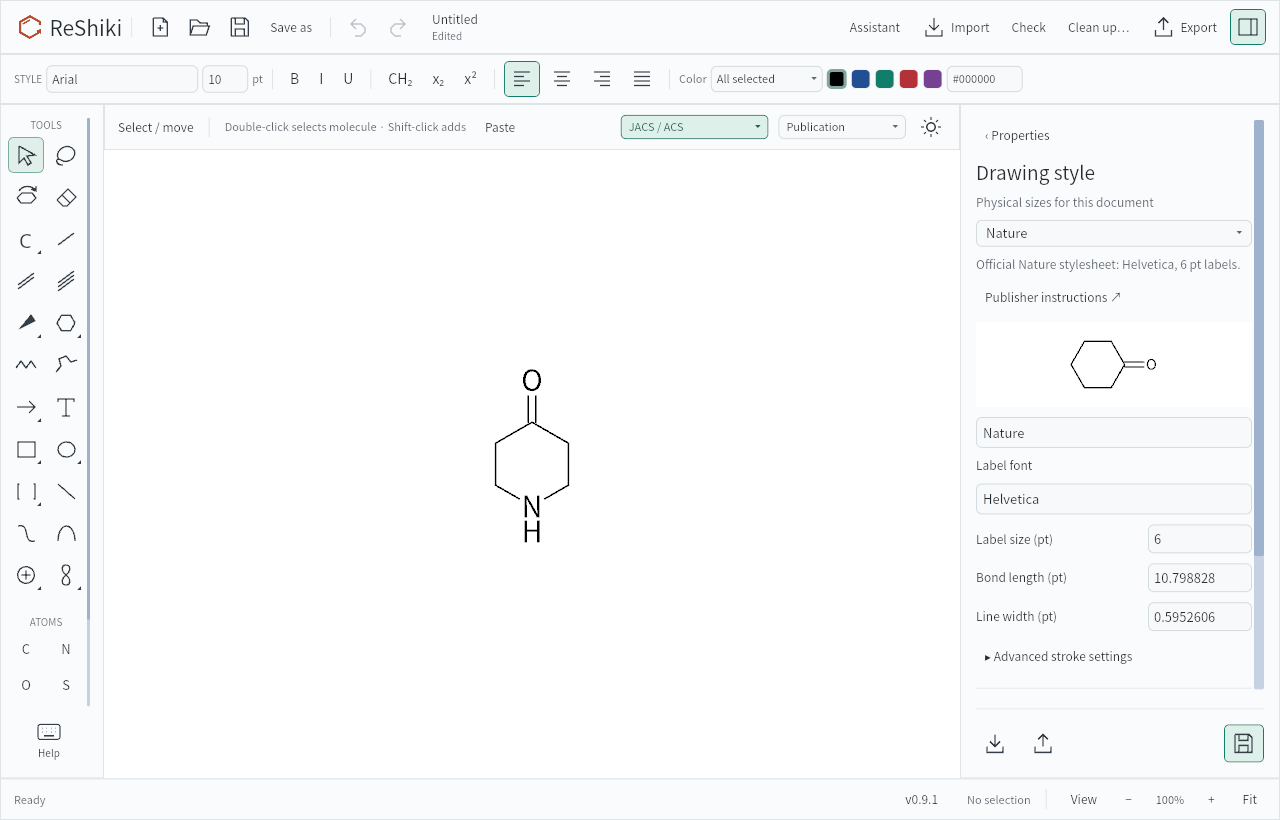
On 2026-09-29, the synthetic fixture was corrected to point its carbonyl outward from the top ring vertex and show the nitrogen’s hydrogen. The original fixture’s crowded bond angle was an input problem, not evidence of a WGPU rendering defect. All 11 GPU cases passed again. The representative captures below use unselected desktop views and were inspected for molecular geometry, readable text and clean presentation. Selection-control captures remain in the full test artifacts.
| Light desktop | Dark desktop |
|---|---|
 |
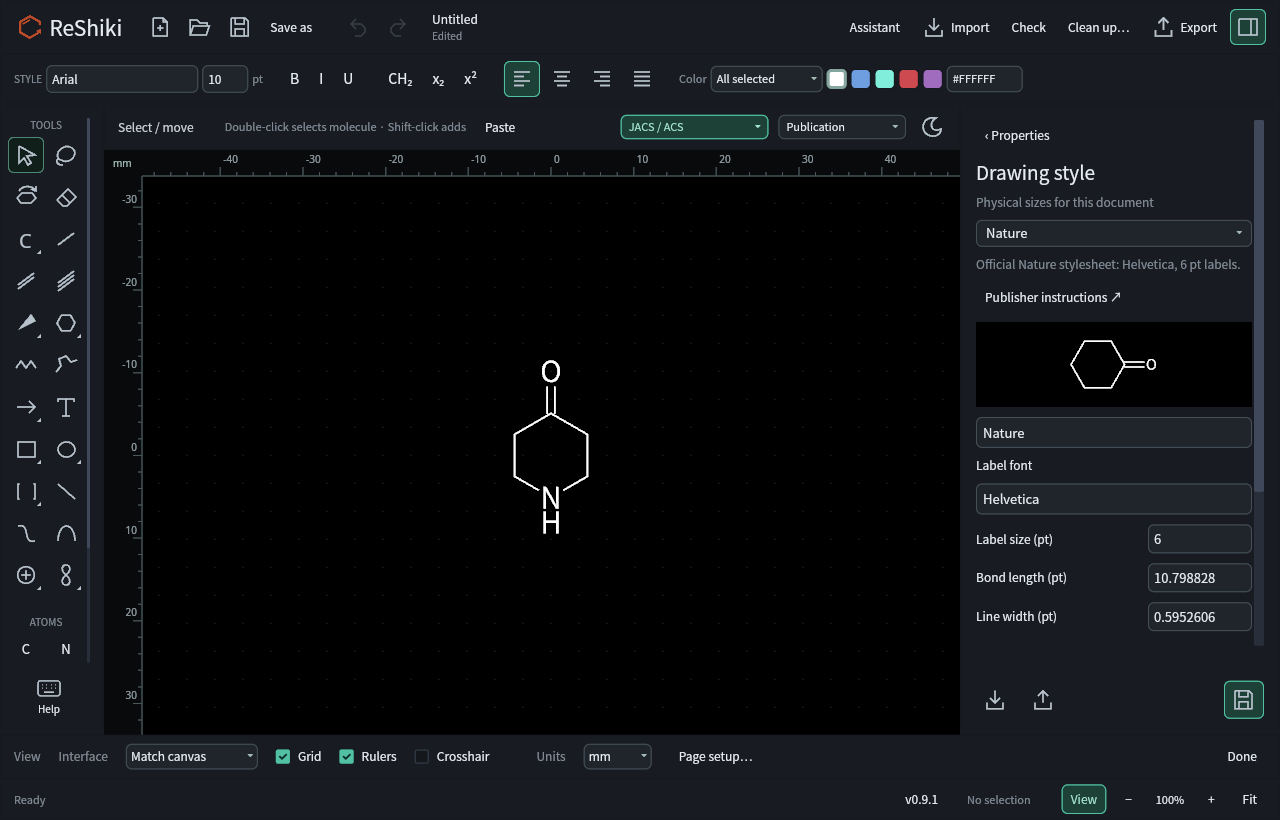 |
These are offscreen rendering checks in a debug test build, not measurements of
window presentation, input latency or frame rate. They establish Linux hardware
rendering and do not establish a Windows performance improvement. Captures, the
original test log and device trace are retained locally in
artifacts/wgpu-linux-20260928/. Corrected captures and their test log are in
artifacts/wgpu-linux-20260929/.