ReShiki 0.14.0
ReShiki 0.14.0 names structures with a new offline structure-to-name engine
and tells you whether each name is the preferred IUPAC name. Name import reads
more kinds of names, and an optional PubChem lookup covers common names. The
release adds Fischer projections, D/L, axial and steroid α/β descriptors,
IUPAC drawing conventions for double bonds, wedges, charges and salts, and
new template groups. 3D models flag stale conformers, and crystal models gain
ORTEP ellipsoids. The release also ships the first reshiki Python package
and touch drawing and real Save in the browser editor. Installed applications
still work on your computer without Python, RDKit or uv.
Release downloads · Previous release · Release validation.
File compatibility
Section titled “File compatibility”Most drawings saved in 0.14.0 still use document version 30 and open in ReShiki 0.13.1. A drawing that uses one of these new features needs 0.14.0:
| Version | Feature in the drawing |
|---|---|
| 31 | A reaction label with a custom gap to its arrow |
| 32 | ORTEP thermal ellipsoids or molecule-only display on a crystal model |
| 33 | A 3D model generated from a structure in 0.14.0, 3D atom labels, or a plain XYZ model |
| 34 | An amino-acid residue collapsed with two attachment points, such as -Ala- between Boc and OMe |
ReShiki 0.13.1 and earlier say that such a drawing was made with a newer version and ask you to update. ReShiki 0.13.0 and earlier cannot open any version 30 drawing. Older drawings still open in 0.14.0. If you share files with someone on an older version, keep a copy saved by that version.
Highlights
Section titled “Highlights”- Structure to name with a preferred-name status. Generated names come from a Rust port of openclatura and must parse back to the same structure. Each name is tagged Preferred IUPAC name, Systematic name, not the preferred IUPAC name or Systematic name, preference not verified, with the reason on hover.
- More names in and out. Salts, isotopologues, radicals, ring assemblies, phane, spiro, r/s, endo/exo and (M)/(P) axis names; Import → Name reads salts, phane names, signed CIP names, peptides and glycans; Look up online… asks PubChem after you confirm each query.
- Stereochemistry and projections. Fischer projections, D/L, steroid α/β and (M)/(P) labels, Invert Configuration Here, Ξ/ξ for unknown configuration and stereo checks in Check drawing.
- IUPAC drawing conventions. Double-bond placement, wedge direction, charge and radical order, partial charges, salt layout, bracket superscripts and hydrogen-isotope labels follow the IUPAC graphical recommendations.
- Templates. Steroids, nucleosides, Fischer projections, coordination geometry frames, 9H purines and IUPAC names in template search.
- 3D models and crystals. Structure changed · Update model, conformer regeneration, 3D atom labels, ORTEP thermal ellipsoids, and boundary copies, Repeat and Look along in the 3D crystal view.
- Python package.
uv add reshikidraws, converts and analyzes structures from scripts, Jupyter, pandas and Excel with the editor’s engine. - Browser editor. Touch drawing, pinch zoom and long-press menus; Save writes back to the opened file in Chrome and Edge.
The changes below keep their contributor credits and links to their issues and reviews. All changes in this release are by @Ameyanagi unless another contributor is named.
Chemical names
Section titled “Chemical names”- Structure to name with a preferred-name status. Structure to name runs on
a Rust port of openclatura
0.4.3 (MIT). Every generated name is parsed back with the OPSIN port and is
refused unless it rebuilds the structure. The Chemical names inspector shows
a status tag under each name, and
reshiki --cli name --jsonreportsstatus,reasonanddetail. A name is Preferred IUPAC name only when its whole path belongs to an audited family and no check finds a departure from the IUPAC 2013 rules; every other name starts as preference not verified. Names known to differ from the preferred name, such as substitutive names where the preferred name is a phane or multiplicative name, are marked not the preferred IUPAC name with the rule. The ordinary name of a cyclophane is marked not preferred, because its preferred IUPAC name is a phane name (P-52.2.5). Chemical names · PR #771, #965, #930, #958. - New kinds of generated names. Charge-balanced salts (
sodium acetate,disodium sulfate), isotopologues, radicals and radical ions; identical ring assemblies ([1,1′-binaphthalene]-2,2′-diol,2,2′-bipyridine); spirobi names; benzo names for benzene fused to a heteromonocycle (1,3-benzoxazepine); multiplied fusion components (difuro[3,2-b:3′,4′-e]pyridine); and every ring of Blue Book Table 2.8, plus pyrrolizine and the phenoxazine family, as fusion components. Simple cyclophanes gain a phane name such as1,4(1,4)-dibenzenacyclohexaphanefor [2.2]paracyclophane, which had no name before. #890, #912, #993, #910, #919, #932, #964, #1013, #1025, #891 · issue #860. - Stereodescriptors in names. Disubstituted cyclohexanes and cyclobutanes
use r/s (
(1r,4r)-cyclohexane-1,4-diol), with cis/trans under Other names. Bicyclo[2.2.1] and [3.2.1] cages list endo/exo/syn/anti names. Atropisomeric biaryls are named with (M)/(P), and Ra/Sa as an alternative. Wavy bonds and undefined centres no longer block a name; an optional setting writes Ξ/ξ for unknown configuration. Descriptor locants are dropped only where the position is unambiguous ((E)-cyclooctene), and E/Z left unspecified by SMILES or InChI input stays unspecified. #889, #898, #901, #899, #911, #909, #988. - Curated aliases and compound classes. The offline alias catalog adds the
21 amino-acid templates (
L-alanine), nucleobases and 24 sugar anomers (β-D-glucopyranose), matched with exact stereo and tautomer. Molecular properties gains a Classes row with chips such as lactam, amide and ester, each with a one-line definition. #891 · issues #861, #862. - Import → Name reads more names. Salts and mixtures (
sodium acetate,triethylamine hydrochloride), rotation signs beside CIP descriptors ((S)-(+)-ibuprofen), peptide and glycan symbols, phane names, (M)/(P) and Ra/Sa axis descriptors and relative or racemic stereo groups. The offline parser follows OPSIN’s main branch (commit42e87ac6) instead of the 2.9.0 release, with its later vocabulary and fixes. An optional Number atoms by name locants writes the parent locants as atom numbers. #887, #751, #888, #962, #933, #973 · issue #731. - Confirmed online name lookup. Look up online… in both naming panels asks PubChem for a common name the offline parser does not know. Each query shows the exact name and destination and needs confirmation; the result opens as an editable preview with its PubChem link, and Insert is a separate step. Local naming stays offline. Reported by @fusion809 in issue #596. Chemical names · Native and browser examples · PR #599.
- Typeset and copy names. Name captions and the inspector set stereodescriptors, locants and fusion letters in italics, with primes, small capitals and λ, as IUPAC prints them; Chemical name typography in View turns this off for new captions. Copy name also puts HTML and RTF on the clipboard, and Copy As → Name names one complete molecule. IUPAC locants in Atom numbers numbers a molecule by its parent locants, and hovering a locant highlights its atom. #875, #874, #888.
- Name corrections. Many generated names now follow the IUPAC 2013 rules
more closely, among them: suffix locant 1 on substituted monocycles
(
2-methylcyclohexan-1-ol); cumulene locants; anionic centres in the parent and cationic before anionic suffixes in zwitterions; phenoxide, alkoxide, azaniumyl and anilinium spellings; contracted phenoxy and alkoxy prefixes; amine oxides (pyridine 1-oxide); toluene and xylene; spiro hydrogen and numbering; indicated and added hydrogen in ring names; salt ion order; and locants omitted only when no isomer exists. Parent and locant choices no longer depend on atom order in the cases reported. SMILES whose cumulene E/Z would be lost are refused instead of named without it. #917, #918, #923, #931, #935, #941, #976, #977, #978, #981, #985, #986, #989, #990, #991, #992, #999, #1000, #1014, #1015, #1016, #1023, #1024.
Stereochemistry and projections
Section titled “Stereochemistry and projections”- Fischer projections, D/L and Invert Configuration Here. A Fischer projections template group (D- and L-glyceraldehyde, open-chain D-glucose and D-ribose, L-alanine, L-serine, sn-glycerol 3-phosphate) stores real configurations, kept in native files, MOL, isomeric SMILES and InChI. Convert to Wedge Drawing and Convert to Fischer Projection keep the configuration of supported acyclic chains in one Undo step. Invert Configuration Here switches a Haworth anomer or epimer, a Fischer centre or an ordinary stereocentre. Atom labels offer Show D/L for amino acids and sugars beside R/S. Fischer projections · PR #894 · issues #866, #867, #868.
- Axial chirality and steroid α/β. Wedged biaryl axes and allenes are perceived and labelled (M) or (P) and kept through MOL and CDXML; allenes also keep it in SMILES and InChI. A pasted SMILES or InChI whose drawing would lose an atropisomer axis is refused rather than drawn without it. Axial descriptors can show Ra/Sa instead. Double bonds between ligands of opposite chirality show (seqCis) or (seqTrans). Steroid α/β labels the ring centres of a gonane nucleus 3β, 5α, … in place of R/S. #892, #1063, #872, #893.
- Stereo checks. Check drawing reports reversed, ineffective, ambiguous and conflicting stereobonds and undefined stereocentres, selects them, and offers Reverse and Redraw stereo bonds, each one Undo step. Undefined units can show a Ξ/ξ marker. #876, #899.
- Wedge conventions. A new wedge puts its narrow end on the atom that can be a stereocentre. Four-substituent stereocentres: wedge + hash pair in Drawing style draws generated structures with a wedge and a hash. #793.
- CXSMILES wedge flags. A SMILES that carries wedge flags imports as the
stereoisomer it states. Without coordinates the
@/@@tags decide the configuration and the flags only shape the drawing, so the drawing, name, SMILES and InChI agree. Reaction SMILES keep the E/Z they state with/and\, and a 3D MOL file’s InChI comes from its own coordinates. #1045, #1050, #1051, #1058. - Singlet and triplet carbenes and nitrenes keep their spin state through
MOL, CDXML and
.rsk. #878.
Drawing conventions and labels
Section titled “Drawing conventions and labels”-
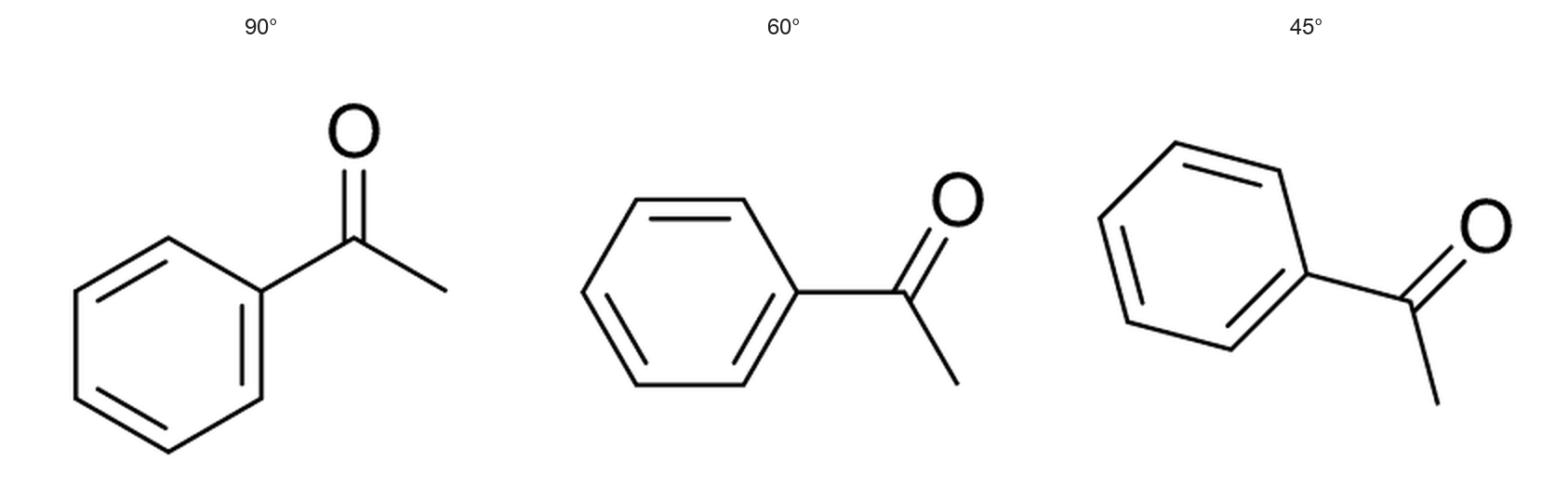
Double-bond placement. Automatic fusion double bonds favour the ring with more other double or aromatic bonds, preferring six-membered rings on a tie. Substituted chain double bonds offset toward an attached ring or the side with more substituents; equal counts follow ChemDraw’s stored-direction tie rule. Terminal heteroatom doubles such as C=O stay centred, and Center chain double bonds in Document Style restores centred chains. Centred double bonds join their neighbouring bonds without a notch, and a rotated C=O keeps a compact gap to its O label. #792, #724, #1027 · issues #778, #779, #780 · Carbonyl comparison · Centred double-bond joins.
-
Charges and radicals. A charged radical prints the dot first (N•+), with an optional mass-spectrometry order. Partial charges δ+/δ− attach to atoms, Make ionic turns a bond from an alkali or alkaline-earth metal to O, N, S or a halogen into an ion pair, and a ring can carry a centred charge. #790.
-
Isotopes and formulas. Deuterium and tritium draw as D and T unless the molecule has another labelled nuclide. Typing D, 13C or 13CH3 makes a real isotope. Displayed formulas list nuclides separately and use IUPAC ion notation; Molecular properties adds a calculated elemental analysis and shows where its atomic weights come from. #879, #877.
-
Brackets and salts. Brackets carry a superscript (‡, +, −, •+, custom), with a Transition state [ ]‡ preset and a Bracket ion command. Salts imported from SMILES, InChI or a name are laid out on one baseline, larger component first, and new layouts follow the IUPAC orientation guidelines. #883, #885.
-
Two-sided residue groups. Amino-acid residues collapse into one label with two attachment points, such as Boc–Ala–Gly–OMe, while every atom stays in the document. Saved as document version 34. #900 · issue #870.
-
Drawing hints. Atom labels and Abbreviations warn when hidden hydrogens or charges change what readers see, or when a label reads as an element. The isotope field is labelled Mass number and checks its element. #873.
-
Straight inserts. Molecules inserted from SMILES, names, InChI or the assistant, and Clean up results, turn by up to 15° so ring and chain bonds sit on the 30° grid. SPhos and XPhos lay out as four separate rings, and codeine imported by name keeps its N clear of the C9–C10 bond. #745, #734, #735.
Templates
Section titled “Templates”- New groups. Steroids, nucleosides and nucleotides, more Haworth sugars, selenocysteine (Sec) and peptide aliases; Coordination geometry frames for square planar, trigonal bipyramidal and octahedral centres; and the Fischer projections group. #881, #882, #894.
- IUPAC search and 9H purines. Template search finds rings by IUPAC and von Baeyer names and nucleobases and sugars by their symbols. Adenine, guanine and purine are drawn as the 9H tautomer, with 7H-purine kept as its own entry. Fused ring parents are added, and previews show locants. #880.
- Browsing. Search inside a category says so and offers Search all, category rows stay in place, and heteroaromatics are listed under Heterocycles. #748.
Reactions, arrows and graphics
Section titled “Reactions, arrows and graphics”-
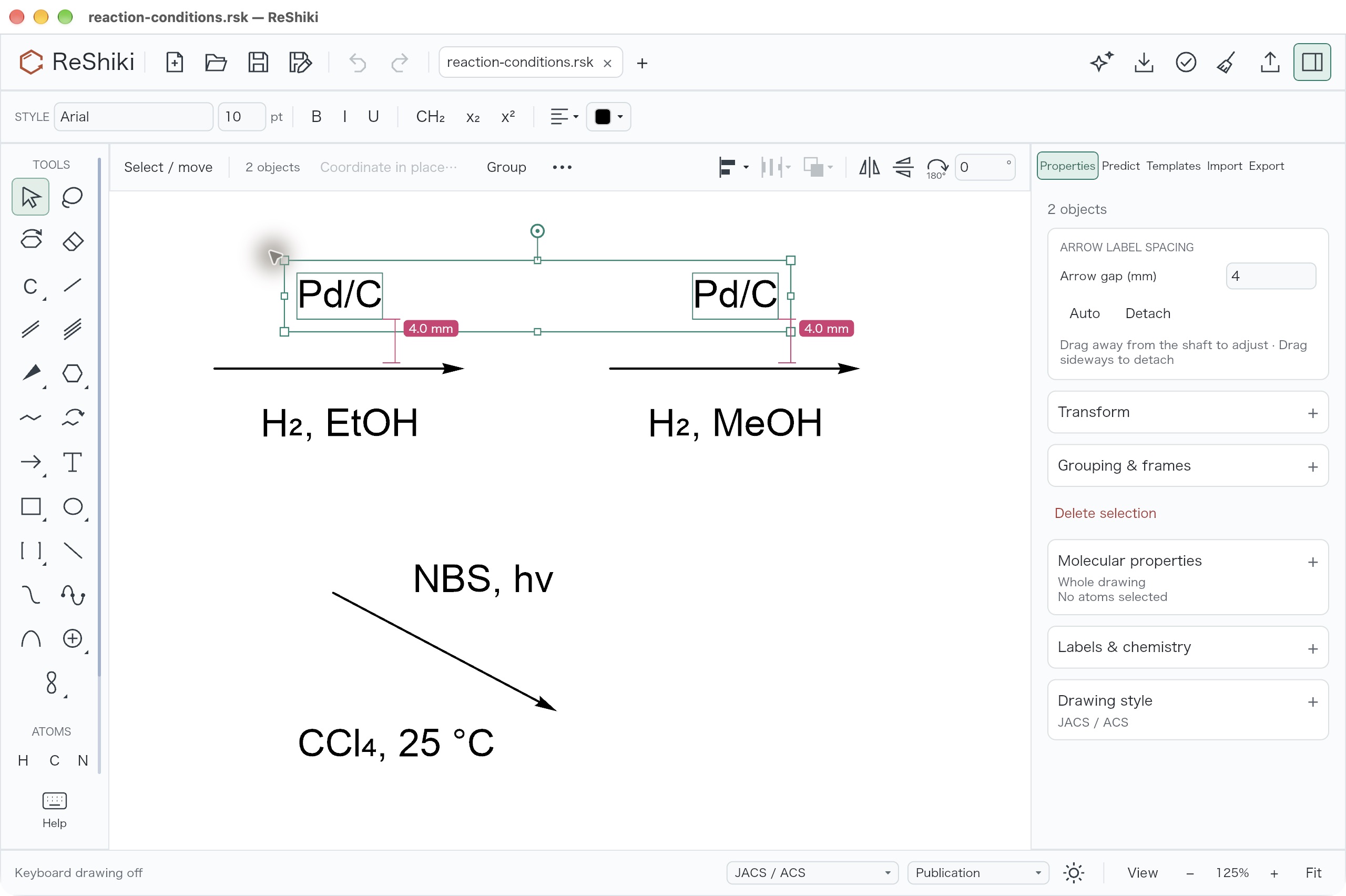
Adjustable reaction-label spacing. Set an attached condition label to an exact gap in the current ruler unit, or drag it perpendicular to the arrow while it stays attached. Several labels share one gap in one Undo step. Custom gaps are saved as document version 31. Adjust label spacing · Native QA evidence · PR #603.
-
Arrow meanings and reaction roles. Reaction roles go only on forward, equilibrium and bent arrows. Arrow presets explain their meaning in the palette and Help, and retrosynthesis arrows round-trip through CDXML. #884.
-
Curved arrows from a bond to its own atom bow clear of the bond, two fishhooks from one bond take opposite sides, and heads follow the shaft. The inline condition editor opens away from its arrow. #739, #607.
-
Pen paths and curves. Nodes are Corner, Smooth or Symmetric. Smooth and Symmetrise tidy pen paths, Bézier curves and curved arrows, and open paths and curves can have arrowheads. #763, #768, #777 · issue #760.
3D models and crystals
Section titled “3D models and crystals”- Stale models and regenerated conformers. A model keeps its conformer after a chemical edit and shows Structure changed · Update model. Update model and Regenerate conformer run in the background, can be cancelled, keep the view and appearance and commit one Undo step. Atom labels offers None, Heteroatoms and All. 3D models · PR #659 · issue #386.
- ORTEP thermal ellipsoids. CIF models with displacement parameters can draw ellipsoids at 30, 50, 70 or 90% probability, with principal-plane outlines and a shaded octant, plus Molecule only and optional solvent hiding. SVG, PNG and PDF export draw them. PR #649 · issue #417.
- Crystals in 3D. The 3D model draws boundary copies, and Repeat and Look along work in 3D and in Both. Disordered CIF files keep the major disorder group and say which one, and crystal ion charges are kept. Space-filling seams stay while a model turns. #757, #754, #755, #758, #759.
Python package
Section titled “Python package”reshikion PyPI. Draw, convert and analyze structures from scripts, Jupyter, pandas and Excel with the same headless Rust engine as the editor. Immutable objects support chained cleanup and styles, and batches report errors per row. Wheels for macOS, Windows and Linux on x64 and ARM64 follow each release, starting with 0.14.0. Install withuv add reshikiorpip install reshiki; the API is experimental. Python guide · PR #611, #936 · issue #608.
Browser editor
Section titled “Browser editor”- Touch. Draw with a finger, pinch to zoom, pan with two fingers and long-press for the context menu. The canvas has a label and status announcements for screen readers. PR #610 · issue #435.
- Save. In Chrome and Edge, Save writes back to the opened file and Save As offers a name and location. Other browsers download a named file and keep the tab marked unsaved. Reopening an open file returns to its tab. PR #612 · issue #428.
- After a reload, the empty canvas offers to restore unsaved drawings. #752.
Desktop
Section titled “Desktop”- Windows Office tabs name their application (
Drawing in PowerPoint.rsk), Paste Special names ReShiki drawing as the source, and the busy cursor ends once ReShiki has taken the drawing. #772 · issues #693, #695, #697. - Linux launchers can group ReShiki windows with their launcher and icon. Reported by @fusion809 in issue #597. Metadata checks and limits · PR #598.
- macOS printing. The print worker closes when the editor quits or crashes. #775.
- Imported files show their source name in tabs and the window title, and restored drafts keep their file name. #606, #752.
- Keyboard focus. Closing Clean up, the 3D preview and Structure import with the keyboard returns focus to the drawing, so the next Delete or Undo acts on it. #954.
- Command palette: full turns do nothing, out-of-range values are greyed before Enter, the dialog opens at the top and names its target, and Copy SMILES, CDXML and MOL copy the whole drawing when nothing is selected (#729, #744, #746).
- Inspector and menus: a closed inspector stays closed on Select all, Molecular properties stays open, and short context menus keep Copy and Delete visible (#749, #750, #974).
- Drawing: implicit-H labels no longer blink after edits, typing an element over a group replaces the group, label-trimmed hashes keep enough marks, automatic charges move clear of neighbour labels, typed subscript digits are real subscripts and long name captions wrap (#736, #732, #733, #738).
- Keyboard drawing: the hotspot stays hidden until you point or type, follows the pointer on 3D models, and group keys attach at ring CH; chain previews grow as you drag (#747, #758, #728).
- Name and SMILES inserts keep the view, and the Clean up Apply button stays reachable (#753).
- Status and wording for exports, paste, Check drawing, atom mapping and recovery; Review atom maps highlights the reviewed pair; broad NMR matches are flagged (#730, #743, #741).
- Exports draw atom labels with a fallback font when no named label font is installed (#791).
- Too much stereochemistry for a SMILES is explained in plain words (#767).
- Assistant: clearer Stop and review-failure messages, a taller composer, legible wide thumbnails, and replies from Codex subagents are ignored (#727, #764, #765).
- Agent API and CLI: analysis numbers are rounded to 9 decimal places, and queued calls are admitted by live count (#773, #956).
Known limits
Section titled “Known limits”- Naming: linear phane and multiplicative names are not generated; such substitutive names are marked not preferred. Phane names are marked preference not verified. Cumulene E/Z is refused. Some parent and locant choices still depend on atom order, and some salt spellings remain unverified (issues #928, #953, #966).
- Stereochemistry:
- A CXSMILES wedge flag on a bond written with
/or\drops the E/Z the SMILES states (issue #1042). - A reaction SMILES wedge flag without coordinates can add a stereocentre the input does not state (issue #1048).
- MOL files open with an atropisomer axis only where the 2D drawing can keep it; 3D files and axes next to a crossed or ring double bond open without the axis (issues #1057, #1064). RXN files with such an axis are refused.
- A CXSMILES wedge flag on a bond written with
- Crystals: after Repeat 2 × 2 × 2, rock salt’s automatic view can still overlap Na and Cl labels; Look along c keeps them apart (issue #614).
- Windows signing: public Windows downloads are unsigned while the SignPath Foundation release certificate is pending. Linux downloads are unsigned.
Build and verification
Section titled “Build and verification”- Python wheels and PyPI. Release tags build abi3 wheels for six targets,
test them on four, and publish
reshikito PyPI through trusted publishing. Releasing · PR #936. - Structure-to-name harness. Golden-status, metamorphic and PubChem round-trip checks for generated names. Harness · #938, #940, #963.
- CI. macOS runners moved to macOS 15, and Rust caches are saved from main only (#737, #605).
- 0.13.1 release validation. The publication record of the tagged source, tag runs and public downloads. Validation record · PR #595.
- Release preparation. Update the version, the release notes and the documentation for 0.14.0.